
Stand behind the counter of a busy UK takeaway at eight o'clock on a Friday and count the screens.
There is the till. There is a tablet for Just Eat, one for Uber Eats, one for Deliveroo, each on its own charger, each with its own chime. There is a card machine that talks to none of them. There is a phone that rings. Somewhere under the counter there is a printer producing dockets in two different formats, and taped to the wall there is a laminated sheet telling staff which items to switch off on which tablet when the lamb runs out.
Every one of those screens is a sale. Only one of them is a till.
That is the whole problem, and it is not the one the industry sells you a solution for. The delivery conversation in this sector is almost entirely about commission rates — a real cost, and we have written about it at length. But a takeaway that negotiated its commission down two points on Monday still has four systems that do not speak to each other on Friday, and that gap costs money in ways that never appear on a single invoice.
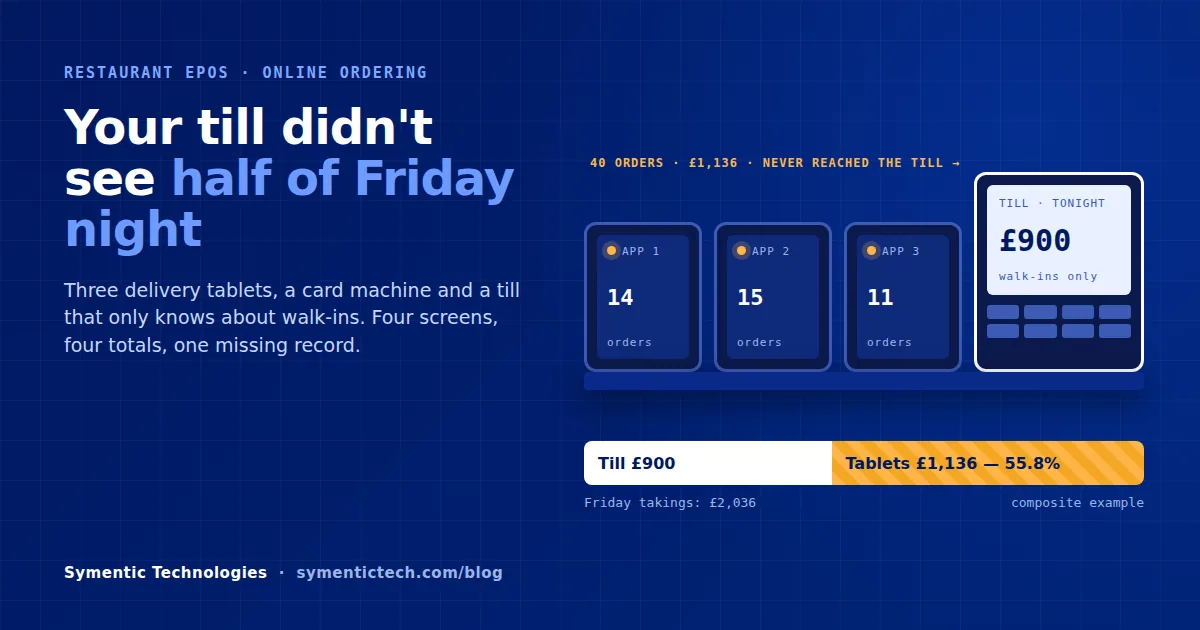
Here is one Friday night traced through all four screens. The numbers below are a composite, not a client: a takeaway doing about 40 platform orders on a busy night across three apps at an average of £28.40, plus £900 of walk-in and phone trade.
The order that gets typed twice
At 20:14, a customer three streets away orders a mixed grill, two sides and a drink. £28.40. The Deliveroo tablet chimes.
What happens next, in most kitchens in the country, is that somebody reads the tablet and types the order into the till — or worse, doesn't, and just shouts it to the kitchen while the tablet sits there as the only record of what was ordered.
That re-type takes about seventy-five seconds, including finding the modifiers. Forty orders a night is fifty minutes of somebody's evening spent transcribing orders that arrived digitally. Two busy nights a week, all year, is about 87 hours — the better part of eleven working days, spent re-keying data that a computer already had.
It also introduces errors. Re-keying under pressure is not a 100% accurate process; at a very forgiving 2% it produces less than one wrong order a night — which sounds like nothing until you count it as 83 a year, each one a remake, a refund or a one-star review, and each one arriving during service when it costs the most to fix.
The requirement: an order placed on a platform should appear on the kitchen screen and in the till without a human retyping it. That is the entire definition of "integrated". Everything else a vendor says about integration is decoration on this one sentence.
Friday night, in four sets of numbers
By eleven o'clock the shop has produced four different accounts of the same evening, and no two of them agree.
The till says £900. It saw the walk-ins and the phone orders. It did not see a single platform order, because nobody typed them in, or because the person who did stopped at nine when it got busy.
The tablets say £1,136. Forty orders at £28.40. Three separate screens, three separate daily totals, none of which can be exported anywhere useful.
The bank says something else entirely, and later — platform money does not arrive nightly, and when it arrives it is net.
The platform statements, when they come, say something else again, because commission has been deducted, refunds for two orders have been clawed back, one order was discounted under a promotion whose cost was shared in a proportion nobody in the shop could tell you, and the driver tips passed through without ever being yours.
Total takings for the night were £2,036. The till saw £900 of it. That is 55.8% of the evening that never touched the till at all.
Hold that number. It is the one that matters for the rest of this post.
The diary version of this problem — and most takeaways run one — is a notebook, a calculator and a Sunday-night session reconciling three app dashboards against a bank statement. That session is where the week's margin is supposed to be checked, and it is done tired, from memory, by the person who also cooked.
The requirement: one figure for the night, from one system, that reconciles to the bank — and, because HMRC does not consider copy and paste to be a digital link, it needs to get into the accounts without a re-type either.
The menu is not one menu
Ask an owner how many menus they maintain and they will say one. Count them.
There is the menu on the wall. The one on the shop's own website. And then one each on Just Eat, Uber Eats and Deliveroo — usually with different prices, because the platform commission has been priced in, and often with different item names, because they were typed in at different times by different people.
That is four to five menus, each edited in a different admin panel. A change made once a week, taking six minutes per channel, is about 21 hours a year of menu administration, against roughly five if the menu lived in one place and published outward. And menu drift is not merely tedious. It produces the two failures every operator recognises:
The item you sold out of at seven is still selling at half past. Somebody has to remember to switch it off in four places, during service. The laminated sheet on the wall exists because nobody can.
The price on one app is wrong. Usually the one nobody checked after the last supplier increase. It stays wrong for months, because nothing in the shop compares the four menus to each other.
And then there is the part that is not an inconvenience but a legal obligation, and which four separately-typed menus make almost impossible to get right.
Allergens have to be right in two places, on every channel
For food sold at a distance — online or over the phone — the Food Standards Agency's position is not that allergen information should be somewhere on the site. It is that "allergen information must be provided at two stages in the order process."
You must provide it "before the purchase of the food is completed - this can be in writing (on a website, catalogue or menu) or orally (by phone)", and again "when the food is delivered - this can be in writing (allergen stickers on food or an enclosed copy of a menu) or orally (by phone)". The FSA goes further on the form it should take: "Our advice to food businesses providing food for delivery or takeaway is that you should make written allergen information available to the consumer both before the food is ordered and when it is delivered."
Now put that against five separately-maintained menus. The allergen data has to be correct and current in the app the customer ordered from — not just on your own website — and it has to travel with the food to the door. A recipe change made in the kitchen on Tuesday has to reach five places before Friday, and in a tablet-farm operation there is no mechanism that makes it, only somebody remembering.
The requirement: allergens attached to the item, once, in the system where the item is defined — and published to every channel from there, and printed on the label that goes out with the order. This is the strongest single argument for a single menu source, and it is not an efficiency argument.
The bit that just changed: HMRC is writing standards for your till
Everything above is an operational cost. This next part is the reason to read the post now rather than in a year.
Over the summer, HMRC ran a consultation — "Electronic Sales Suppression — Introduction of software standards in EPOS/MPOS systems", published 23 June 2026 and open for "8 weeks, from 23 June 2026 to 18 August 2026". It closed a month ago. It is about tills.
Electronic sales suppression is the deliberate misuse of till software to hide sales. HMRC's estimates of the cost have grown: a 2016 report suggested "it could be responsible for £100 million of tax losses", while a 2019 report put it higher, saying "the risk of VAT losses alone could be in excess of £450 million a year". Its own enforcement has scaled sharply — compliance yield "increased from £17 million in 2022 to 2023 to £98 million in 2023 to 2024". The consultation sets this in the context of a small business tax gap of "£28 billion, representing 60% of the overall tax gap of £46.8 billion", with evasion at "£5.2 billion (up from £4.6 billion in 2022 to 2023)".
And it names the sectors. On where the problem sits, the consultation says: "The sectors where this is most prevalent is consistent with the feedback from the 2018 Call for Evidence, meaning small retailers, takeaways and hospitality."
What is proposed is a different kind of till. The measures under consultation include requiring "an unalterable and complete transaction log using the OECD … Standard Audit File for Tax (SAF-T) … data format"; transaction chaining, where "receipts are digitally signed and encrypted and then linked to the previous receipt in the transaction log, thus forming an indelible encrypted chain"; "mandatory information recording by the EPOS/MPOS system, for specific information to be included on receipts"; a "general requirement for the suppliers of EPOS/MPOS systems to protect the integrity" of those systems; and a "register of systems of EPOS/MPOS systems sold, transferred, or used in the UK with a method of certifying" them. The consultation is explicit about what certification would mean commercially: "Systems without certification or that do not meet certain standards would not be permitted to be sold in the UK."
Nothing is law yet. Responses will "inform any future policy proposals to tackle ESS, with any further steps announced in accordance with the tax policy-making process", and the government anticipates "ongoing engagement and cooperation as the measures are developed further". This is the beginning of a process, not the end of one.
But read it next to the 55.8% figure from earlier.
The direction of travel is a till that can produce a complete, unalterable, machine-readable record of every sale. A shop whose till never sees the platform orders cannot produce that record, because the record does not exist in one place — it is spread across three tablets, two of which belong to companies that are not you. Nobody in that shop is suppressing anything. They simply have no system that has seen the whole evening.
That is not a compliance failure today. It is a shop that would have to rebuild its entire order flow to meet a standard of this shape, at whatever notice the eventual legislation gives.
The requirement: every sale — counter, phone, own website, and every platform — landing in one system, with a record that can be exported whole. If you are going to be asked to prove your takings in a machine-readable format, the work is not buying a certified till. It is getting the other 56% of Friday night into it.
What "integrated" actually means
Three arrangements get sold as integration, and they are genuinely different things. A vendor who will not tell you which one they are offering is telling you something.
1. The tablet. The platform's own device, sitting on your counter. This is not integration; it is the absence of it. It is free, it works, and it will still be there in five years if nothing changes. Its real cost is the 87 hours, the 83 wrong orders and the till that saw half the night.
2. Middleware. An aggregator sits between the platforms and your till — the category that Deliverect, Otter and their competitors occupy — consolidating orders from each platform and pushing them into your EPOS, with the menu pushed outward from one place. This genuinely solves the re-keying and most of the menu drift. It is also a monthly per-site fee, a third party in the middle of your order flow, and one more supplier whose outage is your outage. It is the pragmatic answer for a shop with an existing till it likes.
3. Direct integration. Your ordering system talks to the platforms' order APIs itself, and your own website's ordering runs on the same menu and the same order pipeline. No middle party, no per-order toll to a fourth company, and the data model is yours. It is more to build and it is only worth it if the system is going to be run properly — which is precisely the build-versus-buy question and should be answered the same way.
There is a fourth thing worth saying plainly, because it is our own interest and you should discount it accordingly: the cheapest order is the one that did not come through a platform at all. Your own ordering site takes no commission, and it is the easy part of the problem — the hard part has always been that it becomes a fifth screen unless it shares the menu and the till with everything else. An own-channel ordering system that does not integrate is just another tablet you happen to own.
And this is a good moment to note that the platforms themselves are no longer the companies they were when most of these tablets were installed. DoorDash completed its acquisition of Deliveroo on 2 October 2025, after the scheme became effective following court sanction on 30 September; the combination, DoorDash said, "will strengthen DoorDash's position as a global leader in local commerce, enabling the combined entity to better serve businesses, consumers and couriers." Just Eat Takeaway.com has likewise moved into new ownership. Consolidation changes commercial terms and it changes integration roadmaps. Neither is under your control, which is the argument for owning the layer that is.
The tablet farm, costed
What it looks like | What it actually costs | What integration changes |
|---|---|---|
Three platform tablets on the counter | ~87 hours a year re-keying, on the composite volumes above | Orders arrive in the till and on the kitchen screen without a re-type |
Orders shouted to the kitchen from a tablet | ~83 re-key errors a year, all during service | The kitchen ticket is the order, not a copy of it |
Four or five menus in four or five admin panels | ~21 hours a year of menu admin, plus stale prices | One menu, published outward; one price change, once |
"Switch the lamb off on all three" | Sold-out items still selling during service | Stock-out flips every channel at once |
Allergen data typed separately per channel | A legal obligation discharged by memory | Allergens attached to the item, sent to every channel and printed at the door |
Till total vs three tablet totals vs the bank | The Sunday-night reconciliation | One night, one number, reconciled |
Till that saw 44% of the evening | No single complete record of takings | A record that could satisfy a standard of the shape HMRC is consulting on |
Five questions to ask before you sign anything
Each has a yes-or-no answer, and each can be tested in a demo in under ten minutes. Take the demo on your own menu, not theirs.
Place a live order on each platform. Does it print in the kitchen and appear in the till without anyone touching a tablet? Ask to see it happen on all three, not one. "We support Deliveroo" and "we support all three" are different products.
Mark an item out of stock in one place. How long until it is off every channel, and does the system tell me it worked? Watch the clock. If the answer is a sync that runs every fifteen minutes, that is fifteen minutes of selling something you do not have.
Where do allergens live, and what reaches the customer? They should be attached to the item once, published to every channel, and printed on the label that goes out with the food. Ask to see the label.
Export last month. Every order, every channel, every refund and adjustment, as a file. This is the leaving test applied to a till, and it is now also the HMRC-shaped question. If the export needs a support ticket, it is not an export.
Show me one night reconciled. Platform orders, own-website orders, counter, card settlements, commission deducted, refunds — ending in a figure that matches the bank. A supplier who has built this can show it in a demo. A supplier who has not will show you a dashboard.
A sixth, if payments are in scope: everything we said about "we just use Stripe" applies here too, and card mix matters more in a takeaway than anywhere — the difference between a card at the counter and a card online is not a rounding error.
The short version
The delivery commission argument is real, but it is the argument everyone is already having. The quieter cost is four systems that do not talk: about 87 hours a year re-keying orders, 83 avoidable mistakes during service, 21 hours maintaining five versions of one menu, allergen obligations discharged by memory across channels you do not control, and a till that on a busy Friday sees less than half the money.
That last one used to be an accounting annoyance. HMRC spent this summer consulting on EPOS software standards built around an unalterable, complete, machine-readable log of every sale, in a consultation that names takeaways and hospitality as the sectors where suppression is most prevalent. Nothing is law yet and nothing needs to be done this week. But a shop that cannot see its whole evening in one system is a shop with a rebuild ahead of it, and the sensible time to start is while it is still an efficiency project rather than a compliance one.
Count the screens on your counter. If the answer is more than two, the work is not negotiating commission. It is getting the other half of Friday night into the till.
Running three tablets and a till that only knows about walk-ins? We build and run FoodCiti, an EPOS and online ordering platform for UK restaurants and takeaways — one menu, one order pipeline, your own commission-free ordering site alongside the platforms. Run the five questions above on it before you take our word for anything, and check us the way you'd check any supplier. See what we've built, or tell us what your Friday night actually looks like.
Related reading: How much commission do Deliveroo and Just Eat actually charge? · Taking orders online is the easy part · You don't have a card rate, you have a card mix · Every supplier looks the same until you try to leave