Ask an operator what they pay to take a card and you get one number. "One point four." "One sixty-nine." "One-point-three-nine and five p."
That number is not a price. It is the narrowest price on your contract. Advertised rates typically cover one transaction type — a domestic, in-person, consumer card — and everything else is priced above it. Commercial cards sit outside the consumer interchange cap and "can cost meaningfully more". Card-not-present is priced above in-person. Foreign-issued cards are "higher again". Two restaurants on the identical contract, same provider, same headline rate, can finish the year a long way apart on card costs, having negotiated nothing. The difference was who walked through the door and where they tapped.
We've spent this year pulling apart the bills that hospitality businesses can see — delivery app commission, OTA commission, what a software build actually costs. Card processing fees are the bill nobody pulls apart, because it arrives pre-averaged and looks too small to bother with. On £600,000 of card turnover, a half-point of avoidable cost is £3,000 a year. That's the same order as the annual licence for the system you agonised over for six weeks.
So: go and find your last merchant statement. This post is meant to be read next to it.
First, the thing that makes the rest make sense
Your card cost is built from three parts, stacked:
Interchange goes to the bank that issued your customer's card. You have no relationship with them and no ability to negotiate. It is set by card type.
Scheme fees go to Visa or Mastercard for running the network. Also not negotiable. The Payment Systems Regulator's March 2025 final report found the two schemes had raised core scheme and processing fees to acquirers by at least 25% since 2017, costing UK businesses at least £170 million extra a year — and concluded plainly that "the market is not working well."
Acquirer margin is your provider's cut. This is the only part anyone can negotiate, and it is usually the smallest of the three.
Which produces the awkward fact at the centre of this post: most of what you pay is set by which card gets presented, not by which deal you signed. Renegotiating your rate touches the third layer. Changing your card mix touches the first.
And you probably cannot see the first layer at all, because roughly 95% of UK merchants are on blended pricing — a single percentage covering all three components, rising to 98% of merchants under £10 million of card turnover. Blended is not a scam. It is simpler, it is what almost every small business is offered, and for a café with a homogeneous card mix it is fine. But it is structurally a rate that averages away the exact information you would need to lower it: expensive card types are "absorbed inside the average", and the advertised figure "is not the same as a merchant's full effective MSC".
The alternative is interchange-plus (IC+ or IC++), where interchange and scheme fees pass through at cost and the provider's margin is shown as its own line. It is usually pitched at merchants above £10 million. It is worth asking for well below that, and the answer you get is informative either way.
Now go down your statement, line by line
Nine things typically appear. Here is what each one actually is, and whether you can move it.
1. Merchant service charge (MSC). The blended percentage. On UK flat-rate providers this currently runs around 1.39%–1.75% in person and 1.4%–2.5% online, depending who you're with. It is the headline number and it is the least interesting line on the page, because it tells you what you were charged and nothing about why.
2. Transaction / authorisation fees. Typically 3p–5p per authorisation attempt. Note "attempt". A declined card, a retried pre-auth, a deposit that fails twice before it takes — each one is billable. A hotel running card-on-file pre-auths at check-in generates several times more authorisations than transactions, and never notices, because the line is measured in pence.
3. Gateway fee. Around £20 a month for online payments. Separate from the MSC, often billed by a different entity, and frequently still being paid for a gateway nobody has used since the website was rebuilt.
4. Terminal rental. Per device, per month, on a fixed-term contract. Early termination is commonly 50%–100% of the remaining rental. This is the line that quietly decides whether you can switch providers at all, which is a lock-in question rather than a pricing one.
5. PCI compliance fee. Around £4.80–£5 a month for the portal. Fine. What is not fine is the PCI non-compliance fee, which appears when nobody completed the annual self-assessment questionnaire, is an order of magnitude larger, and is entirely voluntary in the sense that you volunteered by ignoring three emails.
6. Minimum monthly service charge. Typically £15–£20. If your MSC doesn't reach it, you pay the difference. Seasonal businesses pay this every January and February and rarely realise the effective rate in a quiet month is double the headline.
7. Chargeback fee. Around £20 per case, charged whether you win or lose. More on this below, because in hospitality it is not a rare event.
8. Refunds. Look for what isn't here: the original processing fee coming back. Stripe's documentation is explicit — "Stripe's processing fees from the original transaction aren't returned." Most providers work the same way. Refund a £200 deposit and you have paid to take money you no longer have. One exception worth knowing: a refund issued shortly after the charge may process as a reversal rather than a refund, which carries lower network costs — a reason to cancel an uncaptured authorisation rather than capture-then-refund, if your system lets you.
9. Cross-border / international / non-UK card fee. Sometimes broken out, often buried. This is the line that matters most to anyone serving visitors, and it is where the next section lives.
The three things that actually move the number
Everything above is a line item. These are the levers.
Lever one: card mix
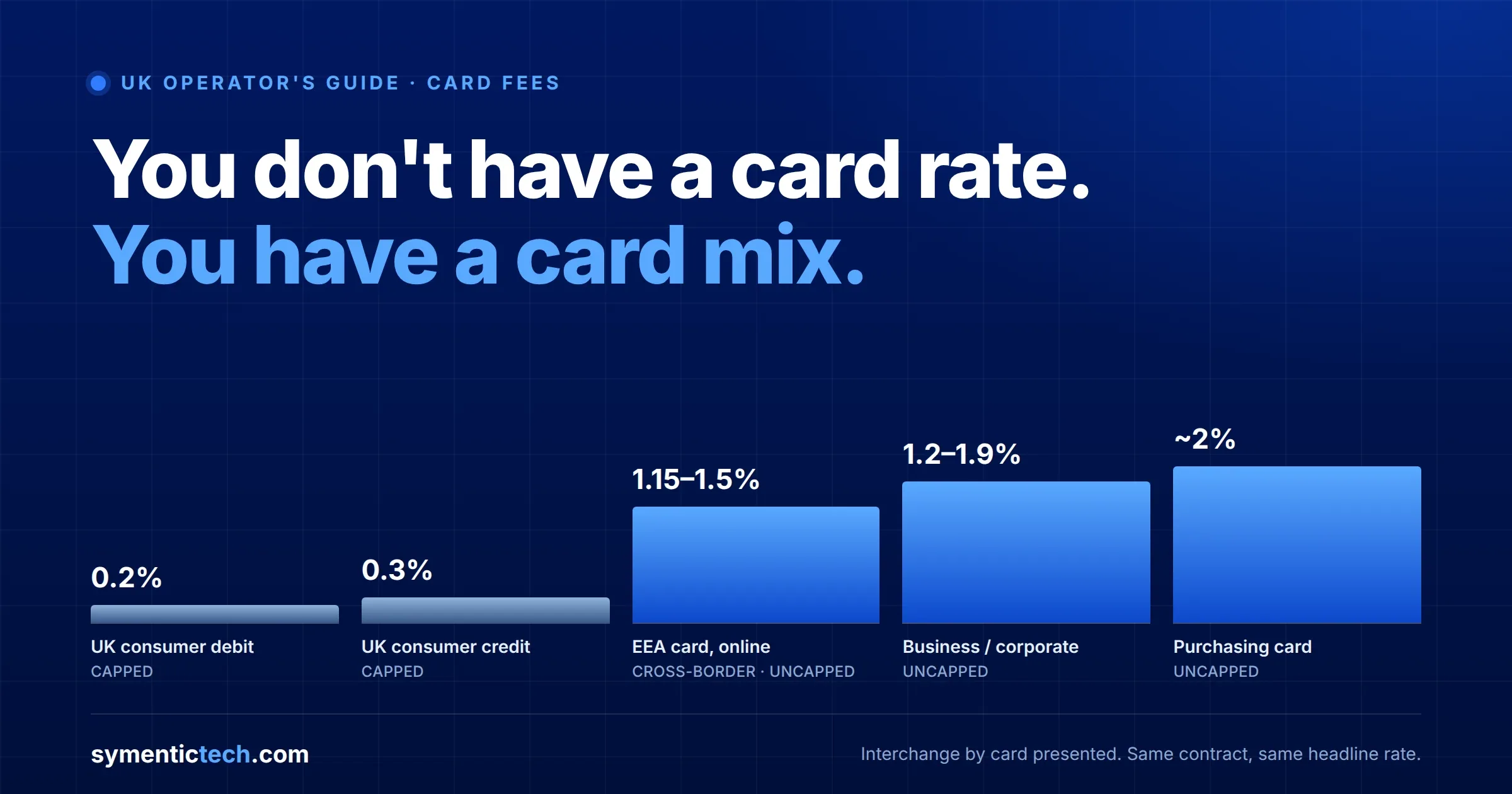
Interchange is set by card type, and the spread is enormous.
Card presented | Interchange | Capped? |
|---|---|---|
UK consumer debit | 0.2% | Yes — statutory |
UK consumer credit | 0.3% | Yes — statutory |
UK business / corporate | roughly 1.2%–1.9% | No |
Purchasing cards | around 2% | No |
The 0.2% and 0.3% caps come from the interchange regulation retained in UK law. They apply to consumer cards only. Commercial cards were never in scope and never capped, which is why a corporate card costs six to nine times a personal debit card to accept.
Now think about which of your transactions arrive on commercial cards. The company Christmas party. The contractor block-booking four rooms for a fortnight. The account customer who settles the monthly invoice on a company card. In a restaurant those are the large tickets, so the expensive interchange lands disproportionately on your biggest sales.
(Amex is a separate animal and doesn't belong in the table above. It is a three-party scheme — no issuing bank, so no interchange — and it charges you a merchant discount rate directly, which is why it sits outside the caps entirely and why it is the rate most operators can actually quote from memory.)
You will pay for that one of two ways, and it's worth knowing which. Either your contract prices commercial cards separately, in which case there is a line on the statement you have never read. Or it genuinely blends them, in which case the cost is absorbed into the average — and the average is what gets repriced at renewal. Nobody eats it for you. The only question is whether you can see it happening.
Lever two: where the payment happens
This is the one almost nobody knows, and for hotels it is worth real money.
When Visa and Mastercard raised UK–EEA cross-border interchange in 2021–22, they took it from 0.2% and 0.3% to 1.15% for debit and 1.5% for credit — a five- to six-fold increase, which the PSR estimated was costing UK businesses an extra £150–200 million a year. Those raised rates apply to card-not-present transactions. Face-to-face, the cross-border rate stays at the capped 0.2%/0.3%.
Read that again as a hotelier. The Dutch couple who book on your website pay you the same £180 either way — but that booking carries roughly five times the interchange of the identical booking taken at your front desk, or as a balance settled on arrival. Same guest, same money, different cost, purely because of where in the stay the card was charged.
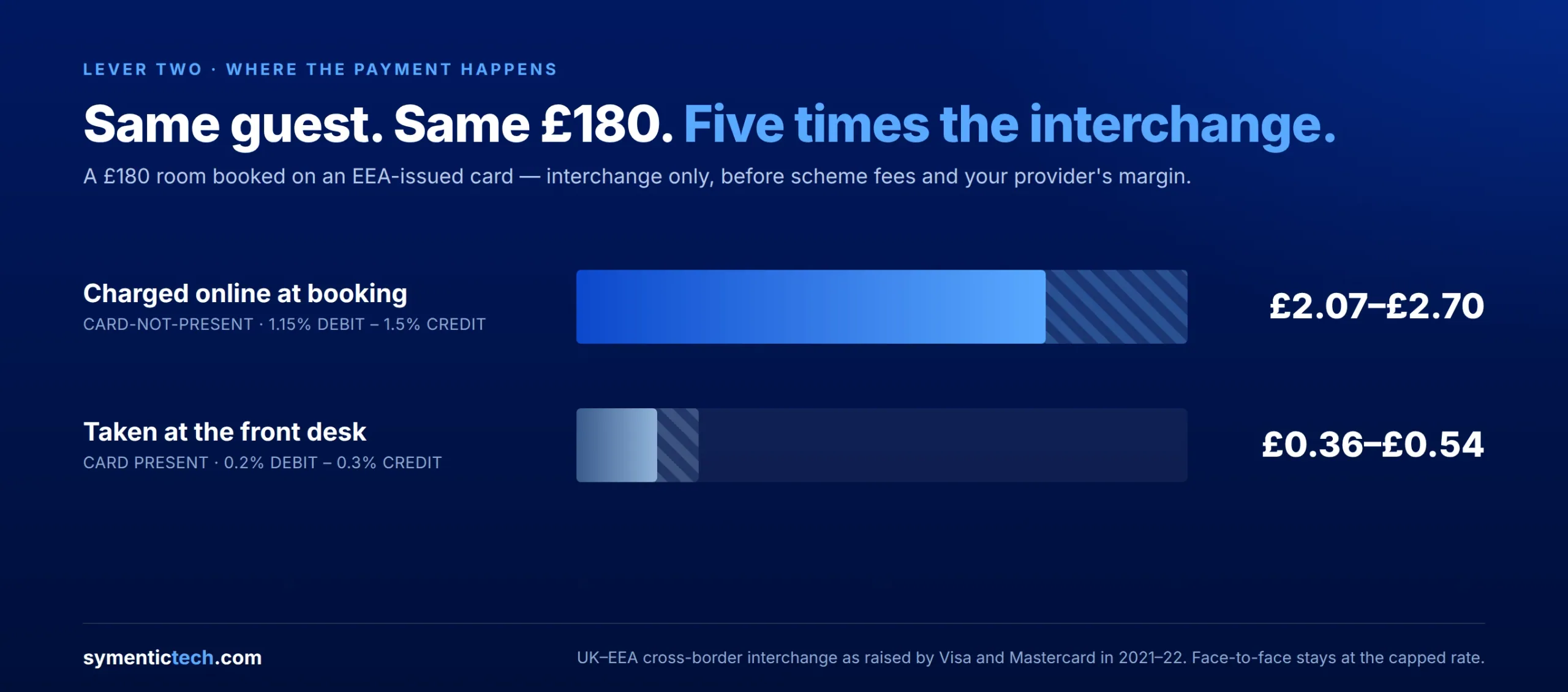
This does not mean stop taking direct online bookings. It emphatically does not mean go back to the OTAs — a point or so of interchange against 17–22% all-in commission is not a close contest, and the direct booking argument is unchanged. What it means is that deposit-now-balance-on-arrival is cheaper than charge-in-full-at-booking, that it was already better for cancellations and cashflow, and that nobody ever included the card cost in that decision because nobody could see it.
Is a cap coming? Probably, eventually. The PSR has been trying to impose one since 2023; it dropped the interim cap while its powers were being litigated, and on 15 January 2026 the Administrative Court confirmed it does have the power under section 54 of the Financial Services (Banking Reform) Act 2013. What it has not done is set a level or a date. Meanwhile the PSR itself is due to be folded into the FCA, which needs primary legislation that has not been introduced.
So this is the third time we have written a version of the same sentence: the protection everyone assumes exists is either somewhere else or not here yet. It was the DMA for hotel rate parity, and the EU Data Act for software switching. It is the cross-border cap now. Price for the world you're actually trading in.
Lever three: average transaction value
Any fee with a fixed pence component is a percentage in disguise, and the percentage is set by your ticket size.
At 1.5% + 20p, a £50 restaurant bill costs 1.9%. A £4 flat white costs 6.5%. Same contract, same day, same card. A provider with a pure percentage rate and no fixed fee looks worse on the big ticket and is dramatically better on the small one — which is why the right answer for a wet-led bar and the right answer for a fine-dining room are different providers, not different negotiations.
Divide your annual card turnover by your transaction count before you compare a single quote. If you have a coffee counter and a dining room, they may genuinely warrant separate merchant accounts.
The bill you are allowed to pass on, and almost certainly don't
Since 13 January 2018, under the Consumer Rights (Payment Surcharges) Regulations 2012 as amended by the Payment Services Regulations 2017, you cannot surcharge a consumer for paying by card. That covers consumer debit and credit, consumer Amex, and wallets backed by a consumer card. Trading standards enforce it. This is well known, and rightly so.
What is much less well known is where the ban stops. Commercial and corporate cards are outside it, and business-to-business transactions are outside it.
Which is the exact inverse of the cost problem. The transactions that cost you the most to accept — the uncapped 1.2%–1.9% commercial cards — are the ones you are legally permitted to price for. The transactions you must absorb are the cheap capped ones.
That is not a licence to start surcharging your corporate accounts tomorrow. It is a strategic option most operators don't know they hold, and it comes with real conditions:
It has to be disclosed in advance — in your terms, on the invoice, and at the point of payment. A B2B surcharge that wasn't agreed beforehand is not enforceable.
Sole traders are judged by the purpose of the transaction, not the entity. A sole trader buying dinner personally is a consumer.
Your acquirer agreement and scheme rules may restrict what you can do regardless of what the law permits. Check before you publish a policy.
And you have to be able to tell a commercial card from a consumer one at the moment of payment — which is a systems question, not a policy question. Most booking engines and ordering platforms never surface the card's product type even though the authorisation response contains it.
If your billing runs through your own software, that last one is a small piece of work with a directly measurable return. If it runs through someone else's, it is another entry for the list of things you cannot change about your own business.
The costs that never appear as a fee
Three, specific to hospitality, that sit outside the statement entirely.
Chargebacks are a hospitality problem, not an e-commerce problem. Lodging has its own dispute machinery: every merchant accepting Mastercard is automatically enrolled in the Guaranteed Reservations Program, a no-show charge has its own reason code, and the chargeback window runs to 120 calendar days from the transaction date. To defend one you need the cancellation policy as it was shown, evidence the guest accepted it, the confirmation number, and proof the charge matched what was disclosed. Without those, you lose — and pay the ~£20 case fee anyway. Guaranteed-reservation rules also require you to hold the room until check-out the following day and cap the charge at one night plus tax. Most independents' terms are written to none of this.
No-show charges are VATable. HMRC's position is that a retained deposit or no-show fee is consideration for the customer's right to benefit from the contract, "regardless of whether the customer exercises that right", VAT is due when the payment is taken, and the payment "cannot be retrospectively re-characterised as an outside the scope compensation payment." So your £50 no-show fee is not £50. It is £41.67 plus VAT, minus interchange on a card-not-present transaction, and it is exposed to a chargeback for four months.
Failed authorisations still bill. Pre-auth at check-in, retry on a declined card, deposit attempts on a card that's since expired — 3p to 5p each. Individually trivial. A 30-room property running two or three attempts per stay generates several thousand billable authorisations a year on top of its actual transactions, and it is the line most likely to be missed when comparing two providers.
What to actually do this week
Four things, in order, none of which require changing provider:
Get the last three statements out and total everything that isn't the MSC. Gateway, PCI, minimum monthly, terminal rental, auth fees, chargebacks. Divide by card turnover. That is your real rate, and it is not the number you quote.
Ask your provider for a card-type breakdown — consumer debit, consumer credit, commercial, and non-UK — split by card-present and card-not-present. If they will not or cannot give you it, you have learned something more useful than the breakdown.
Ask what interchange-plus would look like on your volume. You may not want it. The answer tells you where the margin sits.
Check whether your booking or ordering system exposes the card product type on authorisation. If it does, you have a decision to make about commercial cards. If it doesn't, add it to the list.
Then, and only then, get a comparison quote — because you can now compare on your own mix rather than on a headline rate that describes somebody else's customers.
The short version
You were sold a rate. What you have is an average of your card mix, your channel mix, and your ticket size, plus six or seven fixed charges that don't move with turnover at all.
The capped consumer cards you must absorb. The uncapped commercial cards you're allowed to price for and don't. The cross-border online rate is five times the desk rate for the same guest, and the regulator has had the power to cap it since January and hasn't. Refunds keep their fee, chargebacks cost you whether you win or lose, and a sixth of every no-show charge belongs to HMRC.
None of that is negotiable at the level people negotiate at. All of it is visible, once you stop reading the headline number and start reading the statement.
Want a second pair of eyes on it? We build the payment and booking flows underneath UK hospitality businesses — which means we spend a lot of time in authorisation responses and settlement files, and we've been the merchant as well as the developer. Send us a redacted statement and we'll tell you which of the three levers is worth pulling. See what we've built, or tell us what you're trying to do.
Related reading: Every supplier looks the same until you try to leave · How much commission do Booking.com and Expedia charge? · A channel manager will never win you a direct booking · Your ordering website is the easy part