Ask three takeaway owners what they pay Deliveroo and you will get three different answers. That is not because any of them is wrong. It is because the number genuinely varies — by platform, by whether you or they hand the food to the customer, by how long ago you signed, and by how much leverage you had when you did.
But the ranges are knowable, the arithmetic is simple, and almost nobody does it properly. So here it is: what the platforms charge UK restaurants and takeaways as of August 2026, what that costs against the margin you actually run, and how to work out whether building your own ordering channel is worth it — including the honest answer that for some operators, it isn't.
The short answer
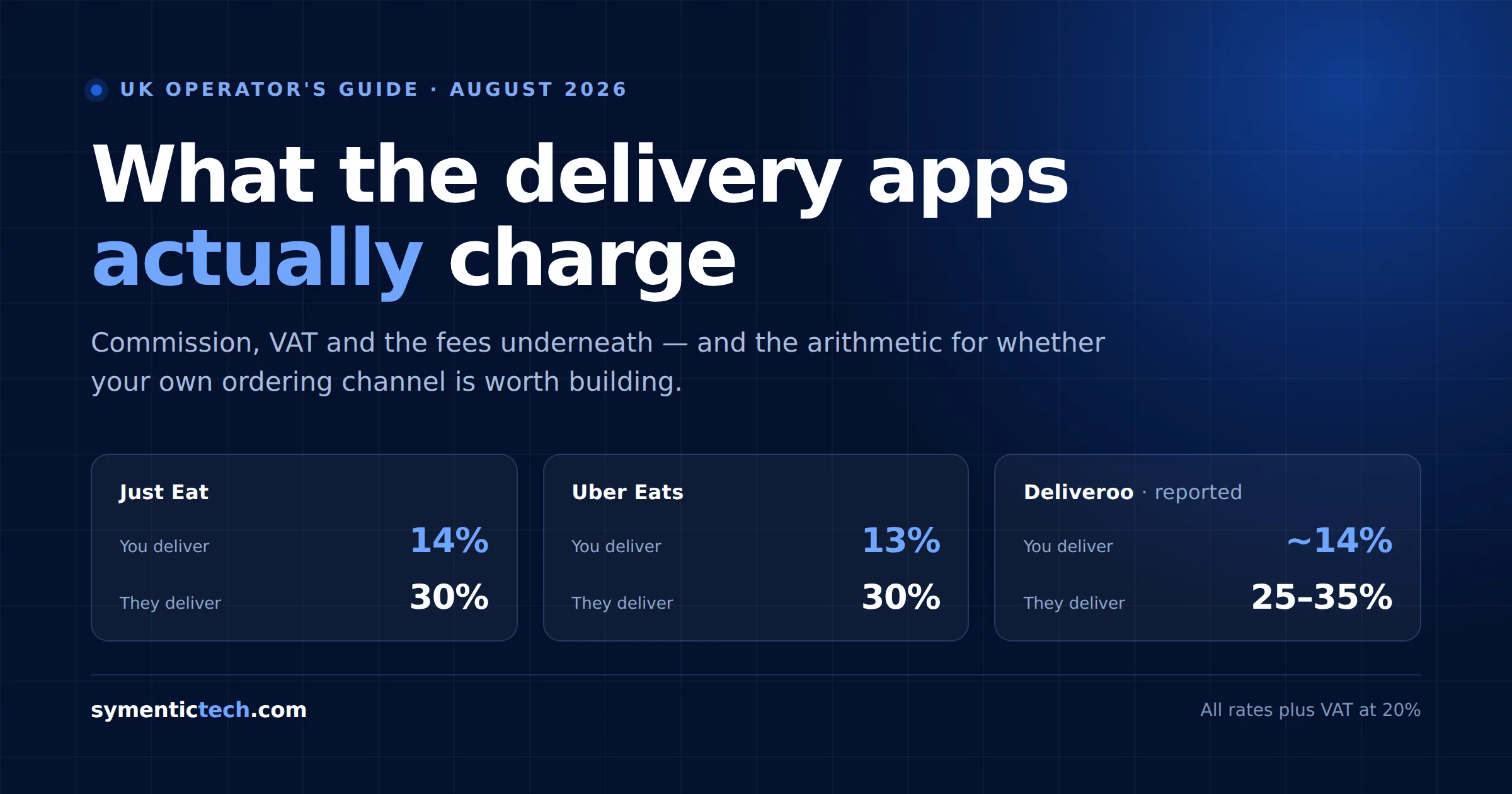
Platform | You deliver | They deliver | Published? |
|---|---|---|---|
Just Eat | 14% + VAT | 30% + VAT | Yes, on the partner sign-up page |
Uber Eats | 13% + VAT (also pickup) | 30% + VAT | Yes, UK merchant pricing page |
Deliveroo | ~14% + VAT (reported) | 25–35% + VAT (reported) | No |
Two things to take from that table before anything else.
The gap between "you deliver" and "they deliver" is enormous. It is roughly double, and on Just Eat and Uber Eats it is the single biggest lever you control. If you already have drivers, or could have, that decision is worth more than any negotiation you will ever have with an account manager.
Deliveroo does not publish rates at all. Every figure you find online for Deliveroo — including ours — is second-hand, aggregated from what operators report. Reported ranges cluster at 25–35% for platform-delivered orders, with exclusivity arrangements at the higher end. Treat it as indicative and read your own contract, because yours is the only rate that matters.
The VAT bit that catches people out
Commission is quoted excluding VAT, and VAT is charged on top at 20%.
So "14%" is really 16.8% of the order value leaving your account. "30%" is really 36%. If you are VAT-registered you reclaim that VAT, and the true cost drops back to the headline rate — but the cash still leaves first, which matters when you are managing a weekly float. If you are below the registration threshold and not registered, the VAT is not recoverable and 30% really is 36%.
That is a meaningful difference on a small takeaway's cash position, and it is the most common thing operators get wrong when comparing an app against any alternative.
What it costs, in pounds
Take a takeaway turning over £5,000 a month through one app, at an average order value of £22 — around 227 orders a month.
On your own drivers, at 14% + VAT: £700 commission, plus £140 VAT. £840 leaves your account each month. Recoverable VAT aside, the real cost is £700 a month — £8,400 a year.
On platform delivery, at 30% + VAT: £1,500 commission, plus £300 VAT. £1,800 leaves each month. Real cost £1,500 a month — £18,000 a year.
Now set that against what you actually keep. UK independent restaurants typically run net profit margins of 3–8%, and quick-service operators around 6–12%. On £5,000 of monthly revenue at a 10% net margin, you are keeping £500. The platform-delivered commission on that same revenue is £1,500.
Which is the point that gets lost in arguments about whether 30% is "fair". The platforms are not taking a share of your profit. They are taking a multiple of it, and the orders only work at all because they are incremental — genuinely new customers who would not otherwise have found you — or because your prices on the app are set higher to absorb it. If neither is true, that channel is losing you money on every order and volume is making it worse.
The fees underneath the headline rate
The commission percentage is the number everyone quotes. It is not the whole bill.
Activation and onboarding. Uber Eats' published UK pricing includes a £650 activation fee, excluding VAT. Just Eat has advertised no upfront joining fee. Deliveroo onboarding costs are negotiated.
Payment processing. Reported at around 2.5% per order on Deliveroo, on top of commission. Check whether yours is bundled or separate — it is often assumed to be included when it isn't.
Per-order admin and service charges. Just Eat has applied a small per-order fee (reported around 50p) alongside commission on some agreements.
Hardware. Tablets, printers and their replacement, on some plans rented rather than owned.
Promotions and sponsored placement. Voluntary, until the day your orders drop and you discover how much visibility you were buying without realising it. Discounts you fund are commissioned on the pre-discount value on some agreements — worth checking yours.
And two contractual terms worth reading before you plan any of this: price parity clauses, which may restrict pricing your own channel below the app, and exclusivity terms, which often buy a lower rate in exchange for not listing elsewhere. Neither is unusual. Both change what strategies are open to you, so find out where you stand before you build anything.
Where the apps genuinely earn their cut
It would be easy — and we build ordering software, so it would be self-serving — to end at "commission is theft". It isn't, and operators who go all-in on that story usually get hurt.
You are buying three real things. Discovery, which is worth most to a new site with no customer base and least to an established one with a queue at the counter. Demand at dead times, filling a Tuesday that would otherwise be empty. Logistics you don't have to run — drivers, insurance, tracking, the phone call when someone's food is late — which is genuinely expensive to replicate, and the honest reason platform-delivery commission is double.
The mistake is not using the apps. The mistake is having no channel of your own, so that after five years of trading, every repeat customer — someone who knows your name, orders the same thing every Friday, and needed no discovery at all — still arrives through a 30% toll booth.
Repeat orders are the ones to move. Discovery you can keep paying for.
What your own ordering channel actually costs
The comparison people make is "30% versus free". That is wrong, and it is why direct-ordering projects disappoint.
Your own channel costs you: card processing, the platform itself (build or subscription), delivery if you are doing it, and the marketing effort to get anyone to use it. Card processing is the easy one — UK online card rates run around 1.5% + 20p for standard domestic cards on Stripe's published pricing.
For our £5,000-a-month takeaway, that is roughly £120 a month, about 2.4% of revenue. Against 14% on the same volume, the gross difference is around £580 a month — call it £7,000 a year — before whatever the platform costs you to build or subscribe to.
But you will not move all of it, and anyone who tells you otherwise is selling something. So do the honest version:
Shift 25% of that volume direct — £1,250 a month — and you save around £145 a month net of card fees, roughly £1,700 a year. That is your realistic first-year number. It tells you exactly how much you can afford to spend on the channel, and it means an off-the-shelf ordering subscription at £60 a month is comfortably worth it while a £15,000 bespoke build is not, at that volume.
Run that calculation with your own numbers before you talk to any vendor, including us. If the answer is that your volume doesn't support it yet, the right move is to keep using the apps and revisit in a year — and we would rather tell you that than build you something you can't justify.
How operators actually shift orders direct
The channel is the easy part. Getting customers to use it is the whole job, and it is unglamorous.
Put it in the bag. A card or sticker on every single order, with a specific offer, not a URL and a hope. This is the highest-return thing on the list because you are reaching people who have already chosen you.
Give them a reason that isn't just price. If your contract restricts undercutting the app on price, compete on the things it doesn't cover: a loyalty stamp, a free side on direct orders, earlier access to specials, a larger menu than you list on the app.
Make it faster than the app, not merely equivalent. Saved details, saved favourite order, reorder in two taps. A direct channel that is slower than Deliveroo will lose to Deliveroo every time, whatever the loyalty scheme says.
Own the phone number and the WhatsApp. Customers who already call you are direct customers who happen to be using a manual system. A link sent back in reply converts far better than a leaflet.
Ask staff to mention it once, at handover. One sentence, every collection order. It costs nothing and it compounds.
Measure the share, not the total. The only metric that matters is the percentage of orders arriving direct, tracked monthly. Total order count will move for a dozen reasons that have nothing to do with your channel.
A 60-day test before you commit to anything
Weeks 1–2 — establish the real number. Pull three months of statements from every app. Add commission, VAT, payment fees, admin fees, hardware, promotions. Divide by revenue through that channel. That percentage — not the headline rate — is what you are actually paying.
Weeks 3–4 — separate new from repeat. Estimate what share of app orders come from customers who order from you regularly. That share is what a direct channel can realistically win; the rest is discovery you are paying for fairly.
Weeks 5–8 — run the cheapest possible version. A basic ordering page, or even a WhatsApp ordering flow with a payment link, promoted only via bag inserts. You are testing whether your customers will switch, not whether the software is good.
Then decide. If 20% or more of repeat customers moved with a minimum-effort test, a proper channel will pay for itself. If almost nobody moved, the software was never the problem and building more of it will not help.
Most direct-ordering projects fail at step two, because nobody ever separated the customers worth winning from the ones the platform genuinely delivered.
Frequently asked questions
How much commission does Just Eat charge in the UK? 14% plus VAT on orders you deliver yourself, and 30% plus VAT on orders Just Eat delivers, per its partner sign-up terms. With VAT that is an effective 16.8% and 36% of order value leaving your account, recoverable if you are VAT-registered.
How much commission does Deliveroo charge? Deliveroo does not publish its rates. Operator-reported figures cluster at 25–35% plus VAT for platform-delivered orders, with lower rates where the restaurant delivers, and the higher end associated with exclusivity arrangements. Your contract is the only reliable source.
How much does Uber Eats charge UK restaurants? Its published UK merchant pricing puts self-delivery and pickup at 13% and platform delivery at 30%, plus VAT, with a £650 activation fee excluding VAT. Uber Eats has revised its UK tiers more than once, so check current terms in the merchant dashboard.
Which delivery app takes the least commission? For self-delivery, Uber Eats at 13% and Just Eat at 14% are close enough that the difference is unlikely to decide it — order volume in your postcode matters more. For platform delivery the three converge at around 30%, so compare on the fees underneath: activation, payment processing and per-order charges.
Can you negotiate delivery app commission? Rates are negotiated rather than fixed, and volume, exclusivity and category are the levers. Small independents have limited room, but the ask costs nothing, and it is worth making at renewal rather than mid-term. Going in with your own numbers — orders per week, your actual all-in rate — is what changes the conversation.
Is a commission-free online ordering system really commission-free? Free of platform commission, not free of cost. You still pay card processing (around 1.5% + 20p on standard UK cards), a build or subscription for the ordering platform, and delivery if you run it. The realistic comparison is roughly 2–4% all-in against 16.8–36%, not free against 30%.
Should I leave the delivery apps entirely? Rarely, and almost never in year one. The apps do real discovery work. The strategy that works is running both, and moving repeat customers — the ones who need no discovery — onto your own channel over time while the apps keep bringing new ones in.
How long does it take to build an ordering system for a takeaway? An off-the-shelf ordering platform can be live in days and is the correct starting point for most single-site operators. Custom becomes worth considering when you have multiple sites, an EPOS or kitchen system to integrate with, or specific operational requirements the standard products don't handle. The economics, not the ambition, should decide which.
The short version
Just Eat and Uber Eats publish their rates: roughly 13–14% plus VAT when you deliver, 30% plus VAT when they do. Deliveroo publishes nothing and reportedly lands in the 25–35% range. Add VAT, then the fees underneath, and compare the result against a net margin that is probably between 3% and 12% — that is the real picture.
The apps are worth paying for discovery. They are expensive for loyalty. Work out which of your orders is which, and you will know exactly what your own ordering channel is worth before you spend a penny on it.
Working out whether a direct ordering channel makes sense for your business? We build online ordering systems for restaurants and takeaways and custom software for hospitality and food service — and we will tell you plainly if your volume doesn't justify it yet. See what we've shipped, or get in touch.
Related reading: AI that pays for itself in small business software · how to take direct bookings without paying OTA commission