Ask an independent hotelier how their direct bookings are doing and you often get an answer about the wrong system. We're fully connected. Everything syncs. We've just moved channel manager.
None of that sells a room on your own website. A channel manager is plumbing between you and the OTAs. It has never persuaded anybody to book anywhere. Yet it is the system most small properties spend the most time on, and the one they blame first when direct bookings stay flat.
The confusion is understandable — three of these systems overlap, most vendors sell two of them bundled as one product, and nobody in the sales call has any interest in telling you which box your problem is actually in. Booking engine vs channel manager vs PMS is not a shopping comparison — it is a diagnosis. So here is the anatomy, and then the useful bit: the symptoms, and what each one tells you about which box is broken.
The four boxes: booking engine vs channel manager vs PMS
Every booking that reaches your property passes through some combination of these. They are genuinely different jobs.
What it is | What it is not | What happens without it | |
|---|---|---|---|
PMS (property management system) | The system of record. Who is in which room, what they owe, what housekeeping needs to know. Your availability lives here. | Not a sales channel. It has no opinion about the outside world. | A diary, a spreadsheet, and a mistake once a month |
Channel manager | A translator. It pushes your rates and availability out to Booking.com, Expedia and the rest, and pulls their bookings back in. | Not a shop. It cannot take money from a guest on your website. | Manual updates on five extranets, and eventually a double booking |
Booking engine | The checkout on your own website. Shows real availability, takes the card, confirms the room. | Not a marketing channel. It converts demand; it doesn't create it. | A "check availability" button that sends people to an email form — or to Booking.com |
OTA | A marketplace with an audience, rented at roughly 15–25% commission | Not a partner, and not a customer list you own | Fewer bookings, and a much harder first year |
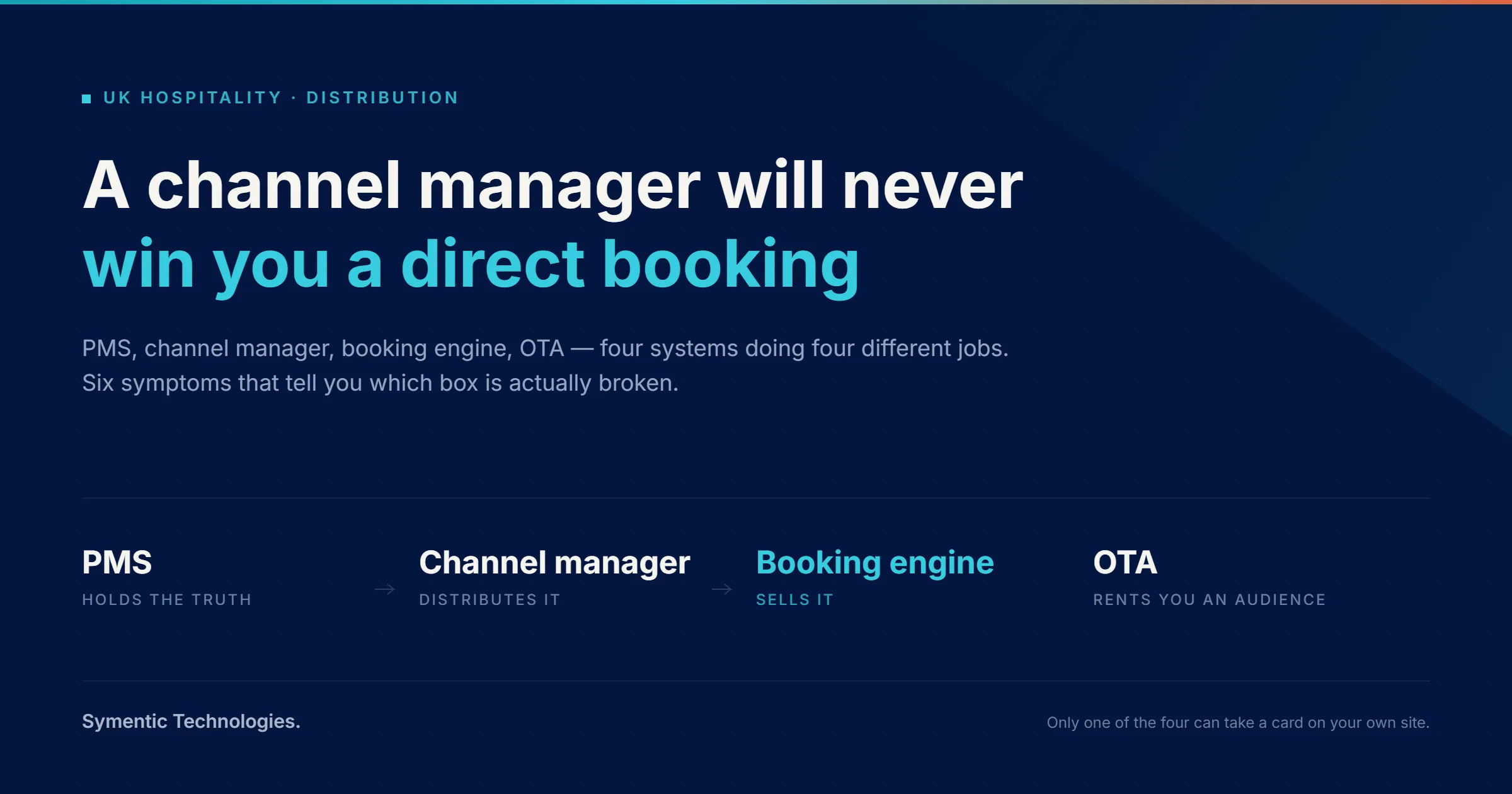
The relationship between them is one-directional in a way that matters: the PMS holds the truth, the channel manager distributes it, the booking engine sells it. A booking taken anywhere should land back in the PMS within seconds, and the PMS should immediately tell the channel manager to reduce availability everywhere else.
When that loop is tight, the whole thing is invisible. When it isn't, you get symptoms.
Six symptoms, and what they actually mean
1. "We still get double bookings, and we have a channel manager"
The channel manager is doing its job in one direction only, or something is writing availability outside it.
The usual culprits, in order of frequency: someone is still editing rates directly in a Booking.com extranet, which the sync then fights; a phone or walk-in booking is being written into the diary but not the PMS; or your booking engine is not connected to the same inventory the channel manager reads. That last one is the nasty version — two systems each confidently selling the same last room.
The test is simple and worth doing today. Take a booking on your own website for a date with one room left, then check whether that date closes on Booking.com without anyone touching anything. If it doesn't, you don't have an integration. You have two systems that happen to be installed.
2. "Our website gets traffic but almost nothing books"
This is a booking engine problem, and usually a specific one.
Independent hotel websites convert far worse than chains — a 2019 benchmark of 550 independent properties (skewed towards four- and five-star) put website conversion around 0.73% against 1.9% for group hotels, and booking engine conversion at 3.28% against 6.8%. Current benchmarks put a typical hotel site somewhere in the 1.5–3.5% range, with mobile far below desktop. The gap between an independent and a chain isn't brand. It's the checkout.
Three things account for most of it: the engine opens in a different-looking window on a different domain, so the guest feels handed off; it takes more than three steps or asks for an account; and it is unusable on a phone, where most of your traffic now is. Mobile conversion sitting at a third of desktop is normal and it is not a law of nature.
3. "We're on Booking.com but nobody finds us directly"
This is not a systems problem at all, and no amount of software will fix it. It is a demand problem, and it is the reason the "just go direct" advice fails so often.
Worth knowing before you cut anything: roughly 30% of people who book direct started their research on an OTA. The listing is doing work you would otherwise pay for. The goal is not to leave — it is to be the cheapest and easiest place to complete the booking once someone has found you there.
4. "Our direct rate is the same as Booking.com because we have to match"
Check that. It may no longer be true, and this is the single most commercially significant change in hotel distribution in a decade.
Since 14 November 2024, under the EU's Digital Markets Act, Booking is required to allow hotels to offer better prices and conditions on other channels, including their own websites, and is prohibited from restricting that freedom. Booking.com states it no longer uses parity clauses with partners in the European Economic Area.
Here is the catch for UK properties: the UK is not in the EEA. The DMA obligation is EEA-scoped, and Booking's own wording is careful about territory. So the answer for a Canterbury guest house is not "parity is dead" — it's read your contract, and if it is silent on parity, price accordingly. Most UK operators we speak to have never checked, and are matching a clause they may not be bound by.
The same DMA obligations give hotels real-time, continuous access to the data generated by their use of Booking.com, and the right to move it elsewhere. Even where the parity point doesn't reach you, the data point is worth asking about.
5. "We don't show up on Google's hotel results"
Google's free booking links put your own direct rate next to the OTAs in hotel search, marked as the official site, at no cost per click. It is the closest thing to free money in hotel distribution right now.
The reason you're not there is almost always mechanical: a property cannot list itself. Rates and availability have to be synced to Google through an approved integration partner — in practice your booking engine or channel manager — and your Google Business Profile has to match what that system sends. If your booking engine vendor cannot tell you whether they are a Google integration partner, that is a real answer to a real question, and it is worth more than three features on their comparison page.
6. "Changing prices takes half a day"
You have systems, but no single source of truth. Someone is typing the same number into four places.
Whether this needs fixing depends entirely on scale. At eight rooms and two rate plans, half an hour a week is annoying but survivable. At twenty rooms across five channels with seasonal rates, it is the job that never gets done, which is how a property ends up selling August at March prices.
What a small property actually needs
The honest answer for most UK independents under about fifteen rooms:
Non-negotiable: somewhere the availability truly lives, and a booking engine on your own site that reads it and takes a card. That's it. That is the minimum that lets you sell a room to someone who wants to give you money directly.
Worth it as soon as you list on more than two OTAs: a channel manager. Below two channels, the manual work is smaller than the integration headache. Above two, the maths flips fast — one double booking, one bad review, one relocation cost.
Not yet: a revenue management system, an upsell platform, a loyalty scheme, a native app. Every one of these is sold to twelve-room properties and every one of them is answering a problem you do not have until the first two boxes work.
The mistake we see most is buying in the wrong order — a sophisticated channel manager bolted onto a website with no booking engine at all. That is a property paying to distribute inventory to its competitors, more efficiently.
Four questions that tell you more than any demo
"When a guest books on my website, how long until that room closes on Booking.com — and is that a push or a scheduled sync?" Real integrations answer in seconds and say push. A "sync every 15 minutes" answer means you will oversell on a busy Saturday.
"Does the booking engine run on my domain?" A guest who notices they've left your website converts worse. It is a small technical decision with a direct revenue consequence.
"Can I export my guest list and booking history, in a usable format, whenever I want?" If the answer is anything other than a plain yes, your guest list belongs to your supplier. This is the same question we tell takeaways to ask their ordering platform, and it has the same right answer.
"Are you a Google integration partner for free booking links?" Free distribution to the highest-intent audience there is. Either they are or they aren't.
The short version
A PMS is the truth. A channel manager distributes it. A booking engine sells it. An OTA rents you an audience.
If direct bookings are flat, the problem is almost never the channel manager, and buying a better one will not move the number. Look at the checkout on your own site, check what your contract actually says about parity now that the EU has forced the question, and find out whether your own rate is showing up free on Google.
Then, and only then, worry about the plumbing.
Running a small hotel or guest house and not sure which box is broken? We build booking and property systems for UK independents — and we run Stayvieo, our own hospitality platform, so these are questions we've had to answer for ourselves rather than read about. See what we've built, or tell us what you're running now.
Related reading: How much commission do Booking.com and Expedia actually charge? · Your ordering website is the easy part.