Ask a hotelier what they pay Booking.com and most will say fifteen percent. Look at what actually leaves the account and it is rarely fifteen percent.
That is not because anyone is being dishonest. It is because the headline commission is one line on a bill with four or five lines on it, and the other lines are opt-in — which means most operators agreed to them at some point and have never added them up since.
So here it is: what the major OTAs charge UK properties as of September 2026, where the extra points come from, what the total costs against the margin an independent actually runs, and how to work out whether a direct channel is worth building — including the honest answer that at some sizes, it isn't.
The short answer
Platform | Typical rate | What pushes it higher |
|---|---|---|
~15% base in the UK and most of Europe | Preferred Partner, Preferred Plus, Genius, Payments by Booking.com | |
Expedia Group | 18–20% typical, 15–30% range | Tier, market competitiveness, promotional and visibility programmes |
Airbnb (host-only) | 15.5% flat | Now the standard model as the split-fee option is phased out |
Airbnb (legacy split fee) | ~3% host + 12–14% guest | Being retired through 2026 |
Two things before anything else.
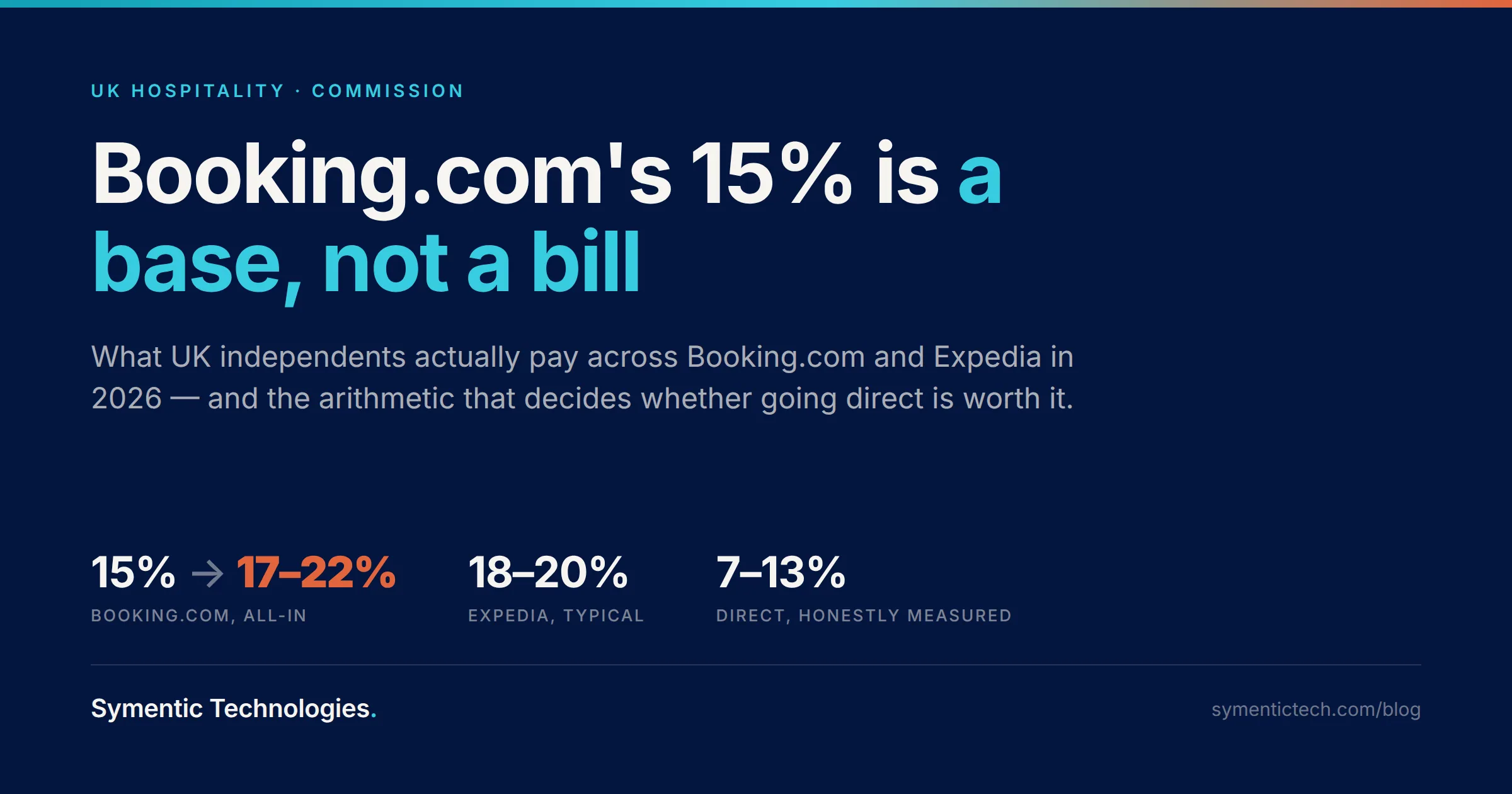
Booking.com's 15% is a starting point, not a rate. It is negotiable, it varies by country and property type, and every visibility programme on the platform is priced in additional commission points. Independents who use those programmes typically land between 17% and 22% all-in.
Expedia is one agreement covering several storefronts. A single contract feeds Expedia, Hotels.com, Vrbo and the affiliate network, which is why its headline rate sits higher than Booking.com's. Rates for independents without a chain's negotiating leverage cluster at the upper end.
Where the extra points come from
Preferred Partner adds roughly 2 to 3 commission points in exchange for ranking priority and a badge in search results. You need to sit in roughly the top 30% of partners by performance and review score to qualify. Booking.com's own marketing puts the benefit at around +65% page views and +40% bookings.
Preferred Plus, the top-tier version, adds around 8 points — taking a 15% property to roughly 23%.
Genius works differently and this is the one operators misread. It does not add a commission percentage. Instead you fund a 10–20% discount for frequent travellers. The commission is then calculated on the booking, and the discount comes out of your side. Measured as an effective cost against your rack rate, that lands somewhere around 1.5 to 3 points depending on how much of your volume Genius members represent.
Payments by Booking.com adds 1.1% to 3.1%, varying by country and payout currency, in exchange for processing, chargeback protection and fraud risk.
Stack the common combination — base, Preferred Partner, Genius exposure, platform payments — and 15% becomes something in the high teens to low twenties, without any single decision feeling expensive at the time it was made.
The cancellation clause worth knowing
Commission is charged on cancellations and no-shows unless you report the no-show in the Extranet, and there is a window on that — commonly cited as 48 hours from the planned check-out. Miss the window and you pay commission on a room nobody slept in.
For a small property with a handful of no-shows a month, that is a genuine four-figure annual leak, and it is entirely administrative. It is the cheapest thing on this page to fix.
The VAT question
Booking.com contracts UK properties through a Netherlands entity, so its commission invoices do not carry UK VAT. For a VAT-registered operator the reverse charge applies: you account for the VAT and recover it in the same return, so it is usually neutral.
The trap is assuming there is input VAT on that invoice to reclaim. There generally isn't, and reclaiming it is a common hospitality VAT error. If you are not VAT-registered, the treatment of overseas-supplied services is a different conversation and worth ten minutes with your accountant rather than a guess.
What it costs, in pounds
Take a 12-room guest house running 75% occupancy at a £105 average rate. That is roughly 3,285 room nights a year and about £345,000 in rooms revenue.
Say 60% of that arrives through OTAs — £207,000 — at a realistic all-in rate of 19%.
That is £39,330 a year in commission.
Now set it against the margin. UK hotels typically run net profit margins of 5–10%; weaker performers sit at 2–5%, strong ones reach 10–15%. At 6% on £345,000, the business keeps £20,700.
The commission bill is close to twice the net profit.
Per room night the same arithmetic is starker. A £120 room night at 20% all-in sends £24 to the platform. At a 6–10% net margin, that same room night earns you £7.20 to £12.
This is the number that gets lost in arguments about whether OTA commission is fair. The platforms are not taking a share of your profit. They are taking a multiple of it. That is defensible when the booking is genuinely incremental — a guest who would never have found you — and indefensible when it isn't.
Worth noting alongside it: regional UK hotels ran a GOP margin of about 30.3% in 2025 on £37 GOPPAR, and that is gross operating profit, before rent, debt, tax and capital spend. With business rates and employment costs both rising into 2026, the gap between GOP and what actually reaches the bottom line is widening. The commission line is one of the few costs on that P&L an operator can still move.
Where the OTAs genuinely earn it
We build booking software, so it would be convenient for us to end at "commission is theft". It isn't, and operators who go all-in on that story usually get hurt.
You are buying three real things.
Discovery — worth most to a new property with no reputation, least to an established one with a waiting list in August.
Demand at dead times — filling a wet Tuesday in February that would otherwise be empty. That room night at 20% commission still beats an empty room at 100% margin on nothing.
The billboard effect — appearing on a platform people browse even when they eventually book elsewhere. Real, hard to measure, and consistently underestimated by operators who want to leave.
The mistake is not using the OTAs. The mistake is having no channel of your own, so that after seven years of trading, the couple who come the same week every year — who know your name, request the same room, and needed no discovery whatsoever — still arrive through a 20% toll booth.
Repeat guests are the ones to move. Discovery you can keep paying for.
What direct actually costs
The comparison people make is "20% versus free". That is wrong, and it is why direct-booking projects disappoint.
Blended across SEO, paid search and email, taking a booking on your own site costs roughly 5% to 12% of booking value. Add card processing on top — around 1.5% plus 20p on standard UK cards — and a realistic all-in direct cost is 7% to 13%.
So the saving is real, but it is a spread of about 8 to 12 points, not 20.
Run it honestly on the guest house above. Move 20% of OTA volume direct — £41,400 of revenue:
At 19% through the OTA, that revenue cost £7,866
At 10% all-in direct, it costs £4,140
Net saving: about £3,700 a year, roughly £310 a month
That number is the whole decision, and it cuts both ways. It comfortably justifies a booking engine subscription at £80–£150 a month. It does not justify a £20,000 bespoke build — not at that volume, not in year one, and anyone who tells you otherwise is quoting you rather than advising you.
Double the property size or the direct share and the answer changes. Which is exactly why you run the arithmetic before you talk to a vendor, including us.
How operators actually shift bookings direct
The channel is the easy part. Getting guests to use it is the whole job.
Beat the OTA on the phone and in the room, not on price. Rate parity clauses restrict undercutting the platform on price. They do not stop you offering a free upgrade, late checkout, a bottle in the room or breakfast included on direct bookings. Value, not discount.
Capture the email at check-in and use it once a season. A guest who stayed and enjoyed it is the cheapest booking you will ever get. Most independents collect the address and never send anything to it.
Make the direct path faster than the OTA's, not merely equivalent. Two-step booking, saved details, live availability, no dead ends. A direct booking flow that is slower or clunkier than Booking.com's loses every time, whatever the loyalty offer says.
Print the direct rate on everything the guest touches. Key cards, room folder, invoice, confirmation email, the card in the welcome tray. You are reaching people who have already chosen you.
Fix the no-show reporting. Not a direct-booking tactic, just money you are currently giving away.
Measure share, not total. The only number that matters is the percentage of room nights arriving direct, tracked monthly. Total bookings move for a dozen reasons that have nothing to do with your channel.
A 60-day test before you commit to anything
Weeks 1–2 — find your real rate. Pull twelve months of platform statements. Add commission, programme uplifts, payment fees, funded discounts, cancellation and no-show charges. Divide by revenue through that channel. That percentage — not the headline — is what you actually pay.
Weeks 3–4 — split discovery from loyalty. What share of OTA bookings came from guests who had stayed before, or who live within an hour, or who booked the same week last year? That share is what a direct channel can realistically win. The rest is discovery you are paying for fairly.
Weeks 5–8 — run the cheapest possible version. An off-the-shelf booking engine on a trial, promoted only through in-room cards and a single email to past guests. You are testing whether your guests will switch, not whether the software is good.
Then decide. If 20% or more of repeat guests moved with a minimum-effort test, a proper channel pays for itself. If almost nobody moved, the software was never the problem and building more of it will not help.
Most direct-booking projects fail at step two, because nobody ever separated the guests worth winning from the ones the platform genuinely delivered.
Frequently asked questions
How much commission does Booking.com charge UK hotels? Around 15% as a base rate in the UK, negotiable by property type and performance. Preferred Partner adds roughly 2–3 points, Preferred Plus around 8, Payments by Booking.com 1.1–3.1%, and Genius costs you a funded 10–20% guest discount rather than extra commission. Most UK independents land at 17–22% all-in.
How much commission does Expedia charge hotels? Typically 18–20%, within a 15–30% range depending on tier, market and programmes. One agreement covers Expedia, Hotels.com and Vrbo, which is part of why the rate sits above Booking.com's headline.
Is Booking.com commission charged on the total booking or the room rate? On the accommodation value including booking-time extras such as cleaning, service or pet fees. Local taxes are generally excluded. Check your own contract — the base is where the surprises live.
Do I pay commission on cancellations and no-shows? Usually yes, unless the no-show is reported through the Extranet within the stated window. This is the most commonly missed refund in the whole relationship.
Can I negotiate OTA commission? Rates are negotiated rather than fixed, and volume, performance score and market position are the levers. A single independent has limited room, but the ask costs nothing, and it lands better at renewal with your own numbers in hand than as a mid-term complaint.
Is it cheaper to take direct bookings? Yes, but not free. Direct acquisition runs roughly 5–12% blended across SEO, paid and email, plus around 1.5% + 20p for card processing. The realistic comparison is about 7–13% against 17–22%, not free against 20%.
Should I leave the OTAs entirely? Almost never, and certainly not in year one. They do real discovery work and fill dates you would not otherwise fill. The strategy that works is running both and moving repeat guests — the ones who need no introduction — onto your own channel over time.
Do I need a channel manager as well as a booking engine? If you list on more than one platform, yes. A booking engine takes direct bookings; a channel manager keeps availability in sync so you do not double-book. For a single-platform property the booking engine alone is often enough to start.
The short version
Booking.com's 15% is a base, not a bill. Add the visibility programmes, the funded discounts and platform payments and most UK independents are paying 17–22%. Expedia typically runs 18–20%. Against a net margin of 5–10%, that commission is not a share of the profit — it is a multiple of it.
Direct is cheaper but not free: 7–13% all-in, honestly measured. The saving is the spread, and the spread only pays for software once enough of your repeat guests actually move.
Work out what share of your bookings are discovery and what share are loyalty. That number decides everything else, and most operators have never run it.
Working out what a direct booking channel is worth to your property? We build custom booking systems and software for hospitality operators — and we run our own platform for independent hotels and guest houses, so we will tell you plainly if your volume doesn't justify a build yet. See what we've shipped, or get in touch.
Related reading: How much commission do Deliveroo and Just Eat actually charge? · AI that pays for itself in small business software