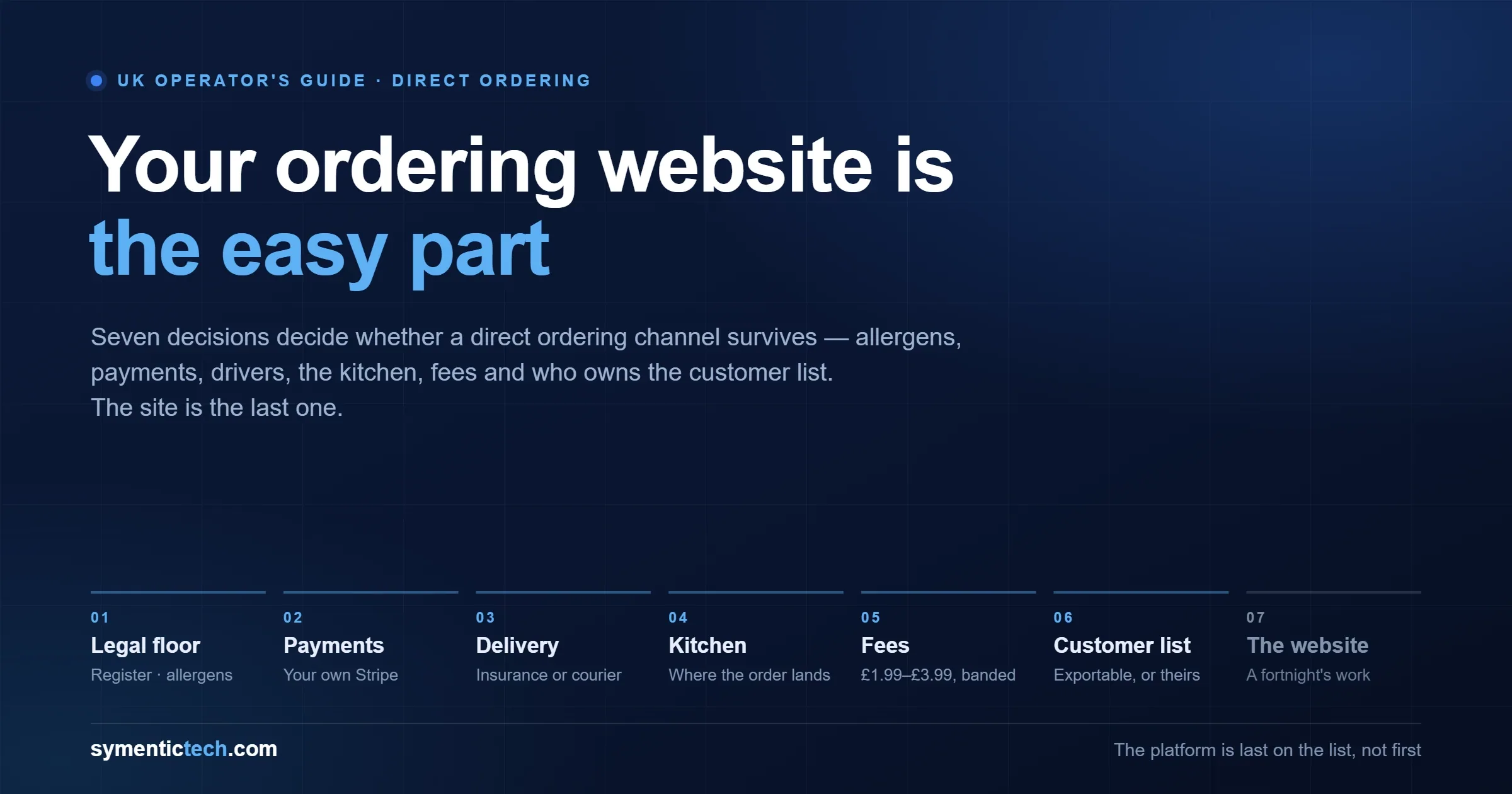
Building a takeaway online ordering site is a fortnight's work and a solved problem. Most operators who set one up still end up back on the apps within six months, and it is never because the site was bad.
It is because the site was the only decision anybody made. The ones that decide whether a direct channel survives are about law, money, drivers, the kitchen and the customer list — and they come in an order, because getting the sixth one wrong makes the previous five pointless.
Here is that sequence, as it actually runs for a UK independent. The platform is the last thing on the list, not the first.
1. Clear the legal floor first
This is unglamorous and it takes an afternoon. Do it before you write a menu, not after your first complaint.
Register the food business. Registration with your local authority is free and must be done at least 28 days before you start trading. If you already trade in person and are only adding delivery, you still need to tell them the nature of the business has changed.
Allergen information has to appear twice. For distance selling — which online ordering is — allergen information must be provided at two stages of the order process: before the customer completes the purchase, and again when the food is delivered. Written on the site and on the bag is the reliable combination. "Ask us about allergens" on a website is not compliance; there is nobody there to ask at 9pm on a Saturday.
This is the single most common gap we see when a takeaway moves from a paper menu to a website, because the paper menu was never the compliance surface — a person answering the phone was.
Your hygiene rating, online. In Wales and Northern Ireland, displaying your rating is the law. On your own website or ordering app, the FSA's rules are about placement: the rating should be prominent, readable, and shown before the point where the customer selects food or places an order. Header or menu top, not the footer. You can use the FSA's own image files or their JavaScript snippet, which updates automatically if your rating changes.
Distance selling rules apply. The Consumer Contracts Regulations 2013 and the Electronic Commerce Regulations 2002 govern what you must tell a customer before they buy — business address, total price, delivery arrangements. Freshly prepared food is exempt from the usual 14-day cancellation right, but the information duties still apply.
2. Decide who actually takes the money
Not "which payment provider" — that is a rate comparison and takes ten minutes. The question is whose merchant account the money lands in first.
If the ordering platform collects payment and pays you weekly, you have handed over your cashflow and your chargeback exposure, and if you leave, the payment history leaves with you. If the payments run through your own Stripe or equivalent account, the money is yours on the normal payout schedule and the customer's card details never belong to someone else's business.
Ask any prospective supplier one question: whose Stripe account is this? The answer tells you what kind of relationship you are entering.
Second question: what happens to a refund at 10pm on a Friday when an order goes out wrong. If refunding requires an email to support, your staff will hand out free food instead, which costs more.
3. Decide who delivers — before you take the first order
Three options, and the cost of getting this wrong is not measured in percentage points.
Your own drivers. Cheapest per drop and by far the heaviest in obligations. Delivering food for payment requires hire and reward insurance — standard business-use car policies explicitly exclude carrying goods for money, so an ordinary policy is void the moment a driver carries a paid order. If drivers are employed, employer's liability cover of at least £5 million is compulsory under the Employers' Liability (Compulsory Insurance) Act 1969, and operating without it can attract Health and Safety Executive penalties of up to £2,500 a day.
Note the trap in "they use their own car and their own insurance". If you set their hours, provide a uniform and do not let them send a substitute, they are likely workers rather than contractors whatever the paperwork says — and the liability lands with you.
On-demand couriers. Stuart, Uber Direct and local firms will deliver your orders without the marketplace, so you pay a delivery fee rather than a commission on the food. Insurance and employment sit with them. It costs more per drop than doing it yourself and vastly less than 25% of the order.
Collection only. The option nobody writes about and the right one for a large number of takeaways. It removes drivers, insurance, delivery zones and most of the operational risk, and a meaningful share of orders in many towns are collection anyway. Starting collection-only lets you prove the ordering channel works before you take on a fleet.
4. Decide what the kitchen actually sees
Every online ordering project that fails operationally fails here, and it never shows up in a demo.
An order has to arrive somewhere a busy kitchen will notice, at a pace the kitchen can absorb, in a form nobody has to re-key. In practice that means one of three things:
A dedicated printer or tablet with an audible alert and an accept step. Simple, cheap, reliable, and someone has to remember to look at it.
Straight into your EPOS. Best outcome — the online order behaves like a counter order, goes on the same ticket rail, hits the same reports. Also the part most likely to be quoted vaguely, because it depends entirely on whether your till maker offers a usable integration.
Email or a web dashboard. Fine at five orders a night. Unusable at forty.
Two questions worth more than any feature list: can the kitchen pause online orders when it is drowning, and can prep times be changed in one tap on a Friday? A system without those turns a good night into a bad review.
If you take one thing from this section: an online order that has to be typed into the till by hand has not been automated. It has been moved.
5. Decide what you charge for delivery
Independents running their own delivery typically charge £1.99 to £3.99 per order. Below that you are subsidising distance; much above it and customers return to the apps, where the fee is buried in a subscription and feels free.
Set a minimum order value, band the fee by distance rather than pretending every drop costs the same, and draw the delivery radius around what the kitchen can serve hot — not around the whole town. The most common self-inflicted wound in direct delivery is a twenty-minute drive at a flat £2.50 fee.
6. Decide who owns the customer — this is the one that matters
Everything above is operations. This is the decision that determines whether the channel is worth having at all.
When an order comes through a marketplace, the customer is theirs. When it comes through your own channel, the name, the phone number, the address and the order history are yours — and that is the entire asset. It is what lets you text three hundred people on a quiet Tuesday, and it is why a direct channel compounds while a marketplace listing does not.
Two conditions on using it.
Check you can export it. Ask any supplier, in writing, whether you can export your customer list and order history, in a usable format, on demand. If the answer is anything other than a plain yes, the customers are not yours; you are renting them on better terms.
Know the marketing rule. You can email or text existing customers under PECR's soft opt-in, but all five conditions must hold: you collected the details yourself, during the sale or negotiation of a sale, the marketing is for your own similar products, you offered an opt-out when you collected the details, and you offer an opt-out in every message. Miss the last one and an otherwise legitimate campaign becomes a breach.
In practice: a tick box at checkout with honest wording, an unsubscribe link in every send, and no buying lists. It is not a difficult rule. It is just one people skip.
7. Then, and only then, decide how anyone finds it
A new ordering page has no customers on day one. The channel does not fail because the software is bad; it fails because nobody used it in month one and everyone quietly went back to the apps.
What actually moves orders, roughly in order of effect:
A card in every bag, including the marketplace ones, with a first-order incentive that is not a discount you cannot afford. Free side, not 20% off.
The ask at the counter. "Next time, order direct — same price, better for us." Regulars respond to this more than any campaign.
Your Google Business Profile. Add the direct ordering link. It is free, it sits above the fold on a phone, and most independents have never touched it.
One text to past customers when you have the list and the consent, timed to a quiet night rather than a busy one.
The menu itself. Printed, laminated, on the wall, on the receipt.
Track one number: the share of orders arriving direct, monthly. Not total orders — share. Total moves for weather and seasons and has nothing to tell you.
A realistic two-week rollout
Week one. Registration and allergen data sorted. Menu written once, properly, with allergens against every item — this is the boring job that everything else depends on, and it takes longer than you think. Payments in your own account. Collection only.
Week two. Live, quietly. Staff take ten test orders themselves. Cards in every bag. Ordering link on Google. Then leave it alone for a month and watch the direct share.
Add delivery when the ordering channel is proven, not before. Add the EPOS integration when the order volume makes re-keying painful. Add the loyalty scheme, the app and the push notifications when — and only when — you have customers who would miss them.
Three things you do not need on day one
An app. Customers will not install an app for a takeaway they use twice a month. A fast mobile web page beats a good app nobody downloads.
A loyalty scheme. Loyalty programmes reward people who were already loyal. Get the orders first.
Every menu variation. Ship the top thirty items. The long tail can wait and it will slow the build by weeks.
The short version
The order is: legal floor, money, drivers, kitchen, delivery pricing, customer ownership, promotion. Most operators start at the platform and back into the rest, which is how a takeaway ends up with a working website, no allergen data on it, and a customer list they cannot export.
Do the afternoon of compliance work first. Keep the payments and the customer list in your own name. Start collection-only.
And be honest about where the difficulty actually sits. Anyone can build you the website in a fortnight. Nobody can do the other six things for you, and they are what the channel lives or dies on.
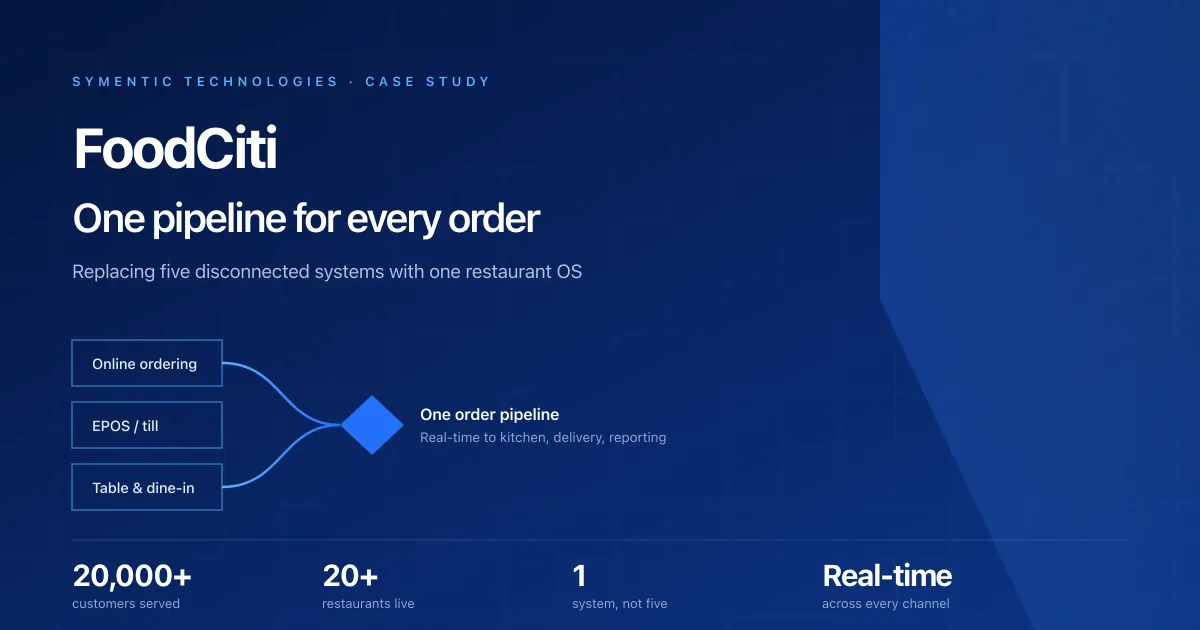
Setting up direct ordering and want the operational side thought through, not just a site? We build ordering systems for UK food businesses — and we run FoodCiti, our own ordering and EPOS platform, so the questions above are ones we have had to answer for ourselves. See what we've built, or tell us what you're running now.
Related reading: How much commission do Deliveroo and Just Eat actually charge? · How much commission do Booking.com and Expedia actually charge?