Open the comparison page for any guest house management software — the kind sold to small hotels — and count the features. Revenue management. Group and allotment bookings. Multi-property dashboards. Night audit. A housekeeping app with a dozen room statuses. Loyalty tiers. Kiosk check-in. Restaurant POS integration. Every one of those was built for a hotel with a night manager, a housekeeping department and a revenue team, and then sold downwards to a property where the owner is also the person cooking the breakfast.
That is why buying guest house management software goes wrong. A twelve-room property cannot evaluate a feature list, because it has no way of knowing which features are load-bearing and which are furniture. It buys the longest list it can afford, uses a tenth of it, and keeps the paper diary anyway.
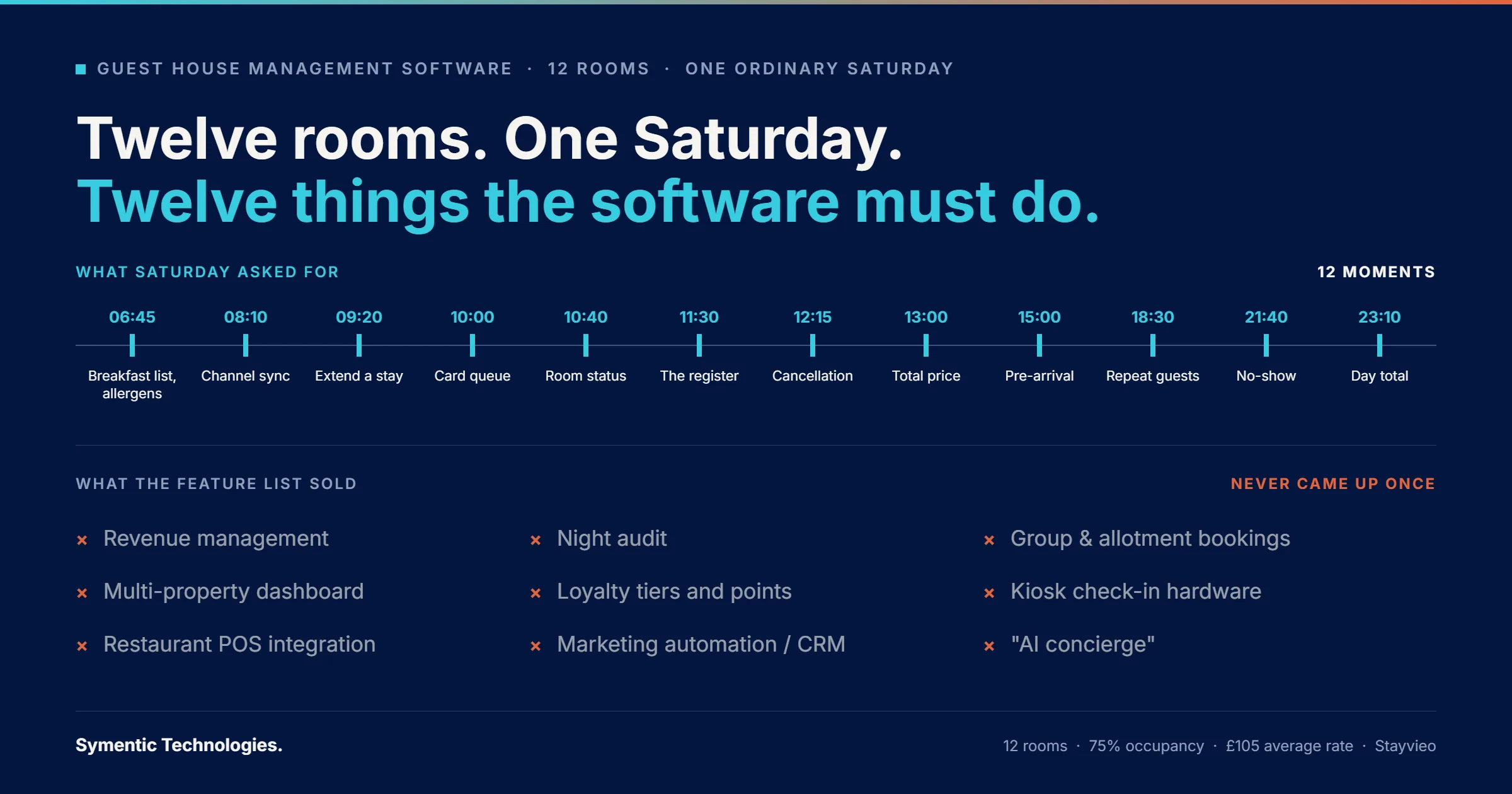
There is a better test: take one ordinary Saturday and walk it through, hour by hour. Every moment the software has to do something is a requirement. Everything else is not. By the end of the day you have a specification you could hand to a vendor, and it is about twelve lines long.
Here is that Saturday. The property is the one we priced OTA commission on two weeks ago: twelve rooms, couple-run, breakfast served, 75% occupancy at a £105 average rate. Ten rooms were occupied last night. Six are leaving this morning, four are staying, and seven are due to arrive.
06:45 — The breakfast list
The first thing the software has to produce is not a report anyone sells. It is a list of who is in the building, which room they are in, how many covers, whether breakfast is in their rate, whether they are checking out today, and the note one of them typed into the special-requests box on Booking.com at midnight about a nut allergy.
That last line is the important one. A guest house that serves breakfast is a food business — VisitBritain's guidance is plain that "if you supply any food or drink, including breakfast, you need to register with your local authority" — and the fourteen regulated allergens have to be communicated to the guest, in writing or verbally. The paper menu was never the compliance surface; the person taking the booking was. Once bookings arrive from four channels overnight, the note has to reach the kitchen without anyone re-typing it.
The diary version: the owner reads the diary, then checks two extranets on a phone while the kettle boils, and the allergy note is in the one they didn't open.
The requirement: one breakfast list, with dietary notes from every channel on it, before 7am, without logging in anywhere else. Nobody sells this report. It is the most-used one in the building.
08:10 — Three bookings arrived overnight
Two through Booking.com, one through the property's own website. For each one, the same thing has to have happened already: that room on that night has been removed from sale everywhere else, before the confirmation email landed.
That is the entire job of a channel manager, and as we said earlier this month, it is the only job it does. When we built our own, the decision the whole system rests on was that the room-night exists exactly once — every channel is a view of one ledger, never a copy of it — because the failure that decision prevents is two guests at the desk at eleven, both holding a confirmation for room 12.
The diary version: three logins, three dates closed by hand. The gap between the booking and the login is the double-booking window, and on a Saturday morning with six departures it is a wide one.
The requirement: here is the ten-minute test. Book a room on your own website for a date with one room left. Does that date close on Booking.com without anyone touching anything? If it doesn't, you don't have an integration. You have two systems that happen to be installed.
09:20 — "Could we stay another night?"
Asked at the breakfast table, with a coffee pot in your other hand. The honest answer depends on whether tonight's room has already been sold on Expedia to one of the seven arrivals. If the software holds one ledger, you know in the time it takes to pour. If it holds four, you say yes and find out at three o'clock.
Saying yes has consequences: tonight's rate is a Saturday rate, not Friday's; the folio has to extend; and the night just consumed has to leave sale on every other channel, now.
The requirement: extend a stay from a phone, repriced, with the channels updated, in under a minute. This is what the "drag the booking to Sunday" demo is actually for.
10:00 — Six departures, three ways of being paid
Six folios to settle, and they are not all the same shape.
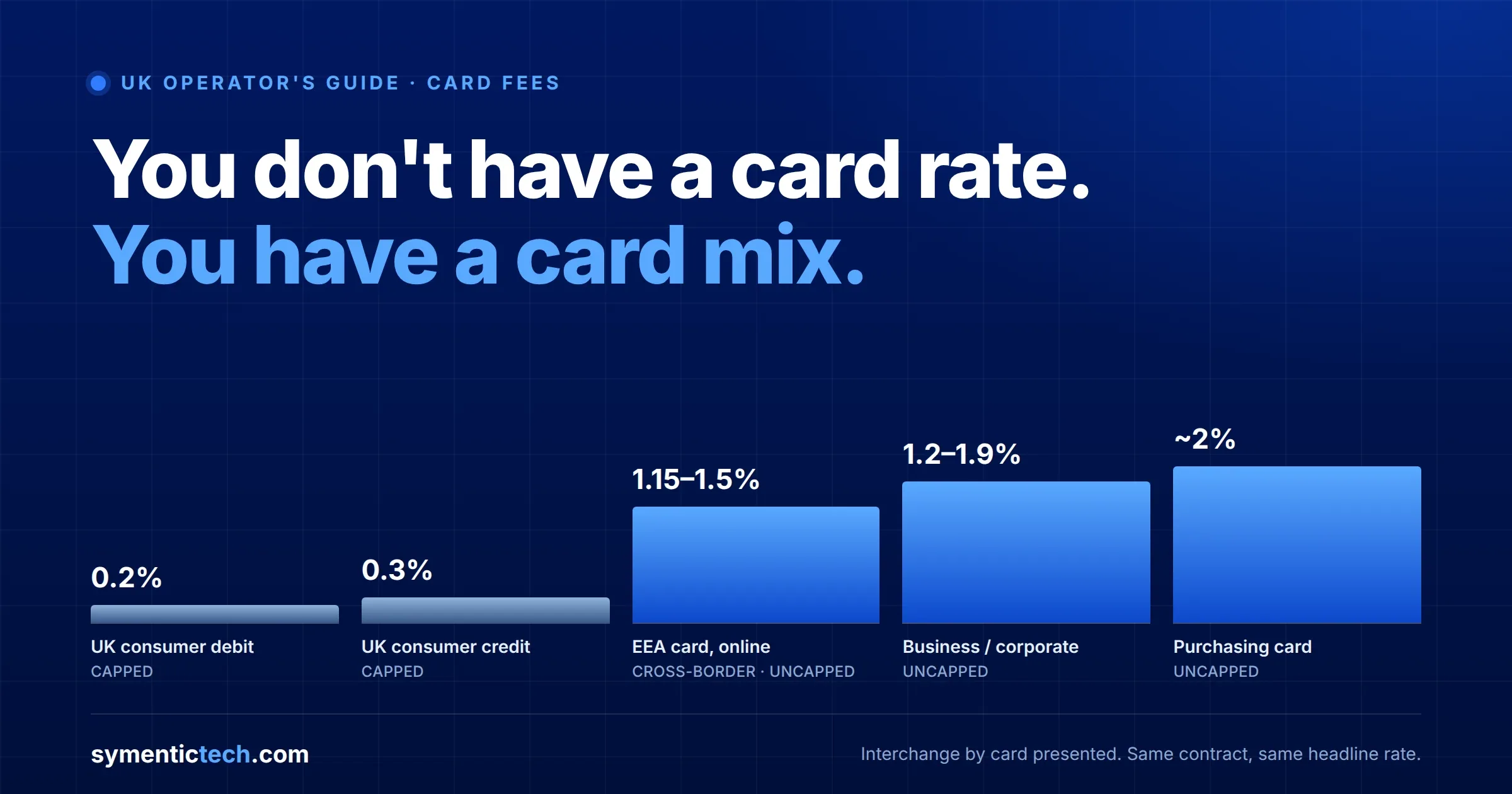
The direct guest paying the balance at the desk. Card present, which — for a guest from Paris in particular — is the cheapest way this money can arrive: interchange on an EEA card is 0.3% at the desk and 1.5% online. Deposit online, balance in person, is a booking-flow decision, not a payments detail. One rule here that still gets broken at small properties: since 13 January 2018 "businesses are not permitted to impose surcharges for paying by a consumer debit or credit card." No 2% card fee, at the desk or on the website. Trading Standards enforce it.
The guest whose card was stored at booking. Charging a stored card with the guest not present is a merchant-initiated transaction, and whether that works on a Saturday depends on decisions somebody made when the booking flow was built. If the answer is "we just use Stripe", it may not.
The Booking.com guest who paid the platform. Booking.com pays you with a virtual credit card — in its words, "temporary, digital Mastercards that we use to facilitate payments from your guests on our platform". For a standard reservation the card can be charged from "one day after check-in" (earlier for non-refundable bookings, or with early activation switched on). And then the line that costs small properties real money: "All VCCs must be charged within 12 months of the check-out date. After this period, you'll lose access to the funds."
That is a queue. Every platform-paid booking is a card that has to be charged inside a window, and the property that handles this with printed confirmations in a tray is the property that finds, at year end, a handful it never charged. It is also the property with card numbers written on paper, which is a different problem — a system built for this vaults the card and charges it from the folio, so nobody at the desk sees a number.
The requirement: a list of virtual cards waiting to be charged, with the date each becomes chargeable, worked through like an in-tray. To find out whether you need it, open the extranet's finance tab and look for unpaid virtual cards from the last twelve months.
10:40 — Housekeeping
Six departure cleans, four stayovers, seven arrivals, two of them early. The board that says which rooms are which has to change when the front desk changes it, because the guest who asked for late checkout at 10:20 has just made the 10:00 printed list wrong.
This is where the feature list overshoots most obviously. A housekeeping app with a dozen statuses is for a hotel with a housekeeping department. A twelve-room property needs three: dirty, clean, checked. Possibly two.
The requirement: a room-status board on a phone, updated from the landing, seen at the desk at once.
11:30 — The register
Something most guest houses do not know is a legal requirement, because it is fifty-four years old and nobody mentions it.
The Immigration (Hotel Records) Order 1972 is still in force and applies to "any hotel or other premises, whether furnished or unfurnished, where lodging or sleeping accommodation is provided for reward." Every guest aged 16 or over must give the keeper "his full name and nationality". A guest who is not a British, Irish or Commonwealth citizen must also give "the number and place of issue of his passport, certificate of registration or other document establishing his identity and nationality", and before leaving, "his next destination and, if it is known to him, his full address there". The record must be kept "for a period of at least 12 months" and "shall at all times be open to inspection by any constable or by any person authorised by the Secretary of State."
A paper registration card usually gets this wrong in both directions. Most cards never ask for nationality, so the record is incomplete. And many properties photocopy the passport, which the Order does not require — it wants the number and place of issue, not the document — and which, under UK GDPR, you then have to justify holding. VisitBritain adds that "you are not legally required to take a guest's home address or contact number" for this purpose at all.
The requirement: a registration record — on the pre-arrival form or at the desk — that captures exactly what the Order asks for, from exactly the guests it applies to, keeps it for twelve months, and then lets it go. Pull last month's cards and check whether nationality is on them. That is the whole audit.
12:15 — A cancellation for tonight
One of the seven arrivals cancels. Two things have to happen now, not on Monday: the room goes back on sale on every channel, because a Saturday night in September will resell by teatime; and the cancellation policy decides whether there is money to collect. For platform-paid bookings, Booking.com's position is that "if there's a cancellation, no-show, or modification to a reservation and you're owed money, we'll send you an email with updated VCC details you can charge" — another card for the queue.
The diary version: the room stays closed on Airbnb until somebody remembers, and the fee is never charged because nobody was sure of the policy.
The requirement: a cancellation from any channel reopens the room everywhere and shows the desk what, if anything, is owed.
13:00 — A direct booking, and the price on the screen
A couple book on your own website for October. Before they click, the booking engine has shown them a price. What that price has to include changed on 6 April 2025, and not every booking engine has caught up.
The Digital Markets, Competition and Consumers Act 2024 put drip pricing into law, and the CMA's guidance states it without hedging: "The practice of showing consumers an initial headline price for a product and subsequently introducing additional mandatory charges as consumers proceed with a purchase or transaction – sometimes called 'drip pricing' – is prohibited." An invitation to purchase has to carry "the total price of the product (including any mandatory fees, taxes, charges or other payments that the consumer must pay if they purchase the product)". The CMA can now enforce this itself, without going to court, with fines of up to 10% of global turnover.
For a guest house that means no "£105" on the room page and "+ £3 booking fee" on step three. No mandatory "cleaning fee" at checkout. And, per the 2018 rule above, no card fee at any step.
Then it gets bigger, because the mandatory charge about to appear on every booking in three parts of the UK is a tax, and your booking engine is the thing that has to collect it.
Your booking engine is about to become a tax collector
Edinburgh has been charging since 24 July 2026. The levy is 5% of the accommodation cost, charged before VAT, on the first five consecutive nights, on every kind of paid overnight accommodation including guest houses and B&Bs. It is not charged on "extras like parking, meals, drinks or transport". Providers "submit quarterly reports, detailing the total accommodation charges and the total levy collected to a national online visitor levy portal", and pay at the same time. VisitScotland's guidance adds two lines that are really software requirements: "The total price, inclusive of the levy, must always be shown at the point of booking", and, for a VAT-registered property, "the visitor levy is treated as part of your taxable turnover and VAT must be applied at your standard rate."
Work that through on the £105 room. The accommodation is £87.50 before VAT; the levy is £4.38; VAT goes on top of both; the guest pays £110.25. Now put breakfast into the rate — say £12 of the £105. The levy applies only to the accommodation portion, so it is 5% of £77.50, not of £87.50, and the guest pays £4.65 rather than £5.25 in levy and the VAT on it. Sixty pence a night sounds like nothing. Across this property's 3,285 room nights a year it is about £1,970 — over-collected from guests, or under-declared to the council, depending on which way the mistake runs. A booking engine for small hotels that does not know the accommodation-only price of a bed-and-breakfast rate cannot get this right.
Wales is registering from next month. Under the Visitor Accommodation (Register and Levy) Etc. (Wales) Act 2025, "from October 2026, you must register your visitor accommodation. You must register by 31 March 2027. Even if your local council does not charge Visitor Levy." Councils that choose to charge can start on 1 April or 1 October of any year, so April 2027 is the earliest. The rate is £1.30 per person per night for hotels, B&Bs and guest houses, and 75p for hostels and camping — where, and only where, a guest under 18 on the first night is disregarded. The Welsh Revenue Authority collects it. Note the basis: per person, per night, with an age rule that depends on the type of accommodation. Not a percentage. A different calculation from Edinburgh's.
England was announced last Thursday. On 10 September 2026 the government confirmed that mayors and the leaders of Foundation Strategic Authorities will be able to introduce an overnight visitor levy, charged "as a percentage of the cost of accommodation, rather than as a flat fee", and expects them to "set out spending plans by early 2028". The consultation response says who does the work: "Accommodation providers will be the persons liable for the levy" and "will calculate and declare levy liabilities through a self-assessment process." No cap on nights, unlike Edinburgh. A third calculation.
So within eighteen months a twelve-room property could be running one of three levy bases — a percentage with a five-night cap, a per-person nightly charge, or an uncapped percentage — and in every case the software has to compute it at the moment of booking, include it in the first price the guest sees, itemise it on the invoice, keep it out of the breakfast, and total it for a quarterly return that you sign. One more wrinkle: check whether each OTA passes the levy through in its payout or leaves it with you. Booking.com's virtual-card guidance already says that "certain fees and taxes may be excluded from the price" and "you'll need to collect them directly from the guest."
The requirement: ask any guest house management software vendor to show you a two-night booking with breakfast, in Edinburgh, from the first screen to the invoice to the quarterly return. If they have not built it, ask when. The diary cannot do this at all, and a spreadsheet will do it wrong.
15:00 — Seven arrivals
Between now and seven o'clock the front desk is also the kitchen, the car park and the phone. The software's job is to have done most of the work before the first car pulls in: a pre-arrival message with directions, parking and the door code, sent the day before without anyone remembering to; the guests' questions from Booking.com chat, Airbnb and the email address on the confirmation in one inbox rather than three; the registration record from 11:30 already filled in online by the guests who did it; and a card captured for incidentals in a way that will actually let you charge it later.
The requirement: one inbox, one pre-arrival message, one registration form, and a check-in that takes two minutes because the guest did the typing at home.
18:30 — The email from the couple who come every September
They would like the same week next year, and the same room. They have stayed four times. If they booked through Booking.com every time, this property has paid roughly £160 in commission on a guest who needed no introduction, and — as we argued two weeks ago — repeat guests are the ones a direct channel is for. Discovery you can keep paying for.
The software should answer a question the diary cannot: which of tonight's eleven rooms are repeat guests, and which channel did they use last time? That list is your direct-booking campaign, and the only one worth running. Emailing it is legal under PECR's soft opt-in, provided you collected the details yourself during a sale, the message is about your own similar services, you offered an opt-out when you collected them, and you offer one in every message.
The requirement: guest history that survives the channel the booking came through, and a report of guests who have stayed more than twice and last booked via an OTA.
21:40 — The no-show
Room 3 did not arrive and did not call. Three things should now happen, in this order. The booking is marked as a no-show. The cancellation policy determines what to charge, and the stored card gets charged for it — which requires that the deposit had proper terms, and that the card was captured in a way that permits an off-session charge; the VAT treatment of what you keep is its own question. And if the booking came through an OTA, the no-show is reported through the platform within its window, because otherwise you pay commission on a room nobody slept in.
The diary version: nothing charged, commission paid, and the room was not put back on sale, though at 21:40 that hardly matters.
The requirement: a no-show button that charges the policy and files the report.
23:10 — The day, as a number
Ten rooms occupied, not the eleven expected: the cancelled room resold at four o'clock, and room 3 never came. Revenue by channel. Deposits taken, balances outstanding, virtual cards charged and virtual cards still waiting. Levy collected, if you are in Edinburgh. VAT. All of it produced from the same ledger the calendar runs on, so that the report cannot disagree with the front desk — and all of it landing in the accounts by a digital link, because HMRC does not consider copy and paste to be one.
The diary version: the Sunday-night spreadsheet. We wrote about that on Wednesday. It is custom software you built by accident, and it marks the exact spot where the software you bought stopped fitting.
The requirement: an end-of-day figure that needs no re-typing and reconciles to the bank.
And then Monday, and the quarter
Monday is the OTA statements against your own records. The end of the quarter is the levy return, signed by you. Twelve months from any arrival is the day the register entry can be deleted. None of these are Saturday jobs, but all of them depend on Saturday having been recorded properly, and the property that runs on a diary does them from memory.
What guest house management software sells that Saturday didn't need
Now read the guest house management software comparison page against the day above.
On the feature list | On Saturday | What a 12-room property needs instead |
|---|---|---|
Revenue management system, dynamic pricing | Never came up | Three or four rate plans — season, weekend, minimum stay — changeable from a phone |
Night audit | Never came up | The 23:10 report. "Night audit" is a hotel concept for a building with a night manager |
Group and allotment bookings | Never came up | Nothing, until you take a wedding party |
Multi-property dashboard | Never came up | Nothing, unless you buy the place next door |
Loyalty programme, tiers, points | Never came up | The 18:30 report and one email a season |
Kiosk or self check-in hardware | Never came up | A door code in the pre-arrival message |
Restaurant POS integration | Never came up | Nothing, unless you run a restaurant |
Housekeeping app with a dozen statuses | 10:40 | Three statuses on a phone |
Marketing automation, CRM suite | Never came up | Guest history that survives the channel, and a soft opt-in tick box |
"AI concierge" | Never came up | Drafted replies inside the inbox you already answer are useful; a chatbot on the website is a demo |
Some of these become real at twenty-five rooms, or with a restaurant, or with a second building. None is the reason to choose a system for twelve rooms, and every one is on the list to justify a price. This is the configure row in practice: a product that mostly fits, whose settings you bend to your property, and whose unused half you pay for at every renewal.
Four questions before you sign
Each of these has a yes-or-no answer, and each can be run in any guest house management software demo in under ten minutes.
Book a room on my website for a date with one room left. Does the date close on Booking.com without anyone touching it? This is the 08:10 test, and a vendor who reaches for the words "near real-time" has just answered it.
Where does the card number live, and can I charge it from here? Virtual cards in a queue with dates, guest cards vaulted rather than written down, a stored card that can actually be charged for a no-show. If any part of the answer involves the extranet's finance tab and a card terminal, keep looking.
If I leave on Friday, what leaves with me? Every guest, booking, payment and registration record, in a format another system can read, on demand. We wrote the long version of this test; for a PMS the honest answer is a CSV of everything, today, without a support ticket.
Show me a two-night booking with breakfast, in Edinburgh, from the first screen to the invoice to the quarterly return. Then ask about Wales. Then ask about the English levy. A vendor who has built none of the three has a roadmap you are about to be on.
The short version
You cannot buy guest house management software from a feature list, because the list was written for a hotel you don't run. Walk one Saturday through instead. It produces about a dozen genuine requirements — a breakfast list with allergens from every channel, one ledger so a booking anywhere closes the room everywhere, a queue of virtual cards to charge before they expire, a register that meets a 1972 Order most owners have never heard of, a booking engine that shows the total price first and can compute a visitor levy on the accommodation part of a bed-and-breakfast rate, an inbox, a no-show button, and an end-of-day figure that reconciles.
Everything else on the list is for a bigger building. And the visitor levy is the item to press hardest on, because Edinburgh is already live, Wales registers next month, and England was announced last week — and in all three the person liable for getting it right is you.
Running a small property on a diary, three extranets and a spreadsheet? We build and run Stayvieo, guest house management software — a PMS and channel manager in one — for independent hotels, guest houses and B&Bs — the kind of property that doesn't have an IT department. It exists because we watched the eleven o'clock problem happen and decided the room-night should exist exactly once. Run the four questions above on it before you take our word for anything. See what we've built, or tell us how your Saturday actually goes.
Related reading: How much commission do Booking.com and Expedia actually charge? · A channel manager will never win you a direct booking · How we built Stayvieo: one calendar, thirty channels · Every supplier looks the same until you try to leave