Somewhere in your business there is a spreadsheet that shouldn't exist.
Someone updates it every Sunday night. It takes numbers out of one system, does something to them, and puts the result into another — or into an email, or onto a whiteboard. It has a tab nobody understands. If the person who maintains it left tomorrow, you would have a problem you couldn't describe to a recruiter.
That spreadsheet is custom software. You commissioned it, you own it, it is unversioned, untested and undocumented, and it is running a real part of your business. Dr Raymond Panko of the University of Hawaii, who has spent a career on this, summarised the field audits bluntly in a 2000 paper: the studies using better methods "found errors in at least 86% of the spreadsheets audited."
So the custom software vs off the shelf decision is not ahead of you. You made it already, by accident, at 9pm on a Sunday.
And that spreadsheet is the single most useful artefact in this article, because it marks the exact coordinate where your bought software stopped fitting your business. Everything below is about reading that mark correctly.
Why the custom software vs off the shelf table is useless
Search custom software vs off the shelf and you get the same table on every page: custom in one column, off-the-shelf in the other, cost / speed / flexibility / support down the side. Off-the-shelf is cheap and fast, custom is expensive and slow, pick according to budget.
Both columns are wrong, and they are wrong in the same direction: they both price the purchase and ignore the ownership.
Off-the-shelf is not the cheap option; the licence is just the visible part. In ERP — the most-studied end of this market — implementation "usually runs 1x to 3x the first-year software fee", and in most mid-market and enterprise projects licence or subscription fees "account for only 20–30% of the first-year total." The rest is configuration, data migration, training and change management. An SME buying a booking system or an EPOS is not running an ERP programme, but the shape holds at every size: the price on the pricing page is the smallest number in the project.
And the subscription does not stay still. Vertice's 2026 index puts SaaS inflation at 13.2%, which it notes is "nearly 5x higher than the standard market inflation rate of G7 countries", with software costs reaching $9,100 per employee by the end of 2025 and "$1 in every $8" of a typical organisation's spend now going on SaaS. Zylo's 2026 index, surveying IT leaders, found 79% hit a price increase at renewal in the past twelve months and 77% found costs that surfaced only after the contract was signed. The same index puts average licence utilisation at 54% — barely half of what those organisations buy is being used. And Vertice's finding on why none of this is obvious: "60% of vendors deliberately mask their rising prices."
Those are enterprise numbers and your business is not an enterprise — but you are buying from the same vendors, on the same renewal calendar, with considerably less negotiating leverage than the people in that survey.
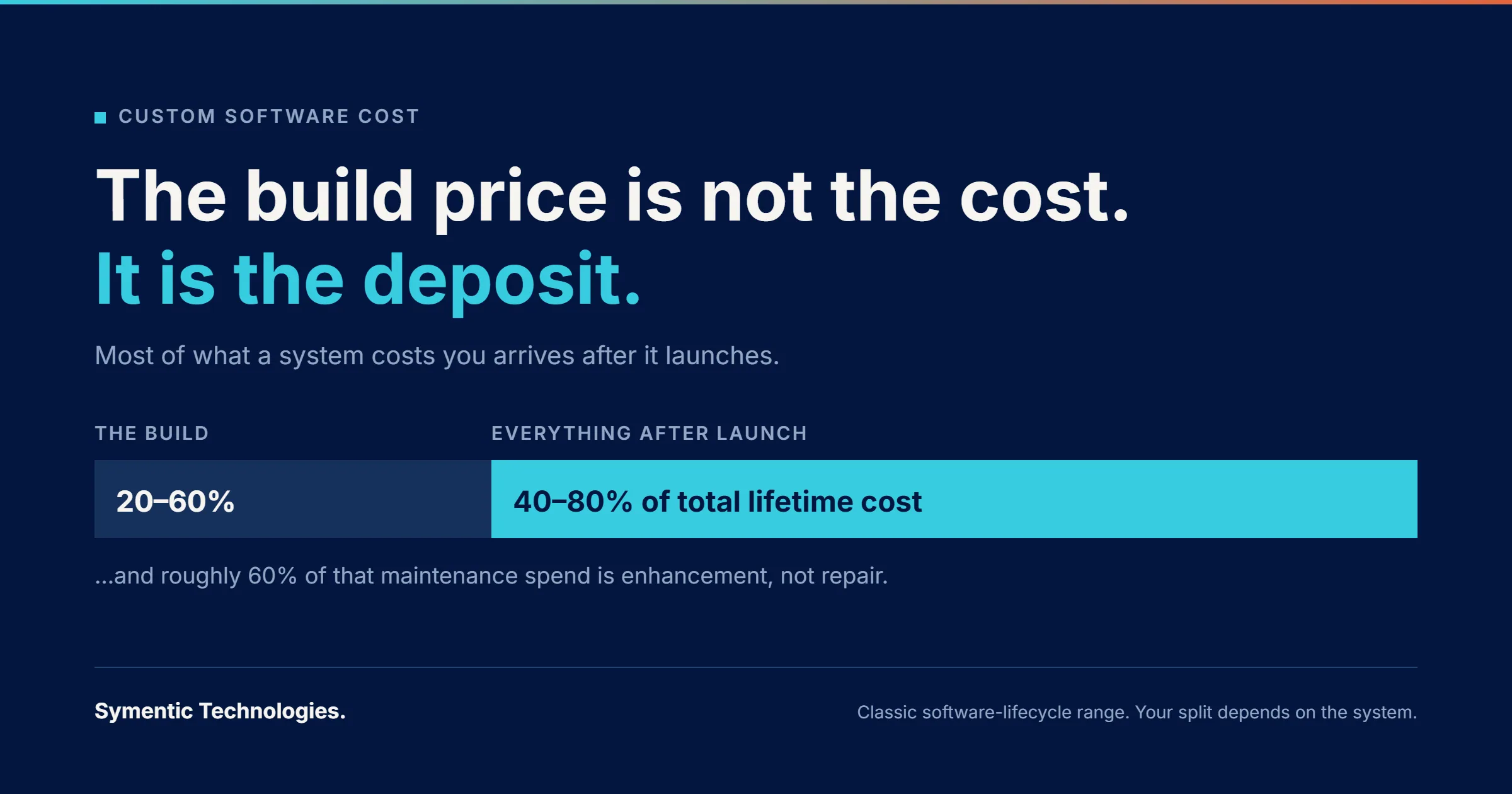
Custom is not the expensive option either, at least not in the way the custom software vs off the shelf table implies. It is expensive differently: most of its cost arrives after launch rather than before, and it is the kind of cost you can decide not to spend in a slow quarter. A subscription is not.
Neither column is a lie. They just describe two ways of paying, and the table invites you to choose between them once, for your whole business, which nobody has ever actually done.
The arithmetic on the option you already picked
You do not need a quote to run this one. You need last month's invoice.
Take what you currently pay for a piece of business software, annually. Apply that 13.2%.
Flat | At 13.2% a year | |
|---|---|---|
Year 1 | £6,000 | £6,000 |
Year 5 price | £6,000 | £9,852 |
Five-year total | £30,000 | £39,036 |
Three things fall out of that, and none of them depend on the £6,000 being your number:
The price doubles in under six years. Compounding at 13.2%, anything doubles in 5.6 years. The tool you bought at £500 a month is a £1,000 a month tool before the contract feels old.
Five years costs about 30% more than five times this year's price — which is almost certainly how you budgeted for it.
That is per seat, before you hire anyone. Grow the team 20% and the two effects multiply rather than add.
Run it on your own figure before reading on. It changes what the rest of this article is worth to you, and it is the only piece of arithmetic here you can do from documents you already have.
Two honest caveats. 13.2% is a global average across a whole market; your particular vendor may have held prices for three years, and some genuinely do. And a build has an equivalent line — maintenance and enhancement, which is not small. The point is not that subscriptions are bad. It is that the ongoing column is the one that decides this, and it is the column the comparison tables leave blank.
The actual question: where does the seam go?
Here is what every business that has been running for more than five years actually looks like. Not custom. Not off-the-shelf. A stack of bought things with something home-made in the gaps.
That is not a failure to decide. That is the correct answer, arrived at badly. And the decision worth making deliberately is not custom software vs off the shelf — it is which layer you own, process by process.
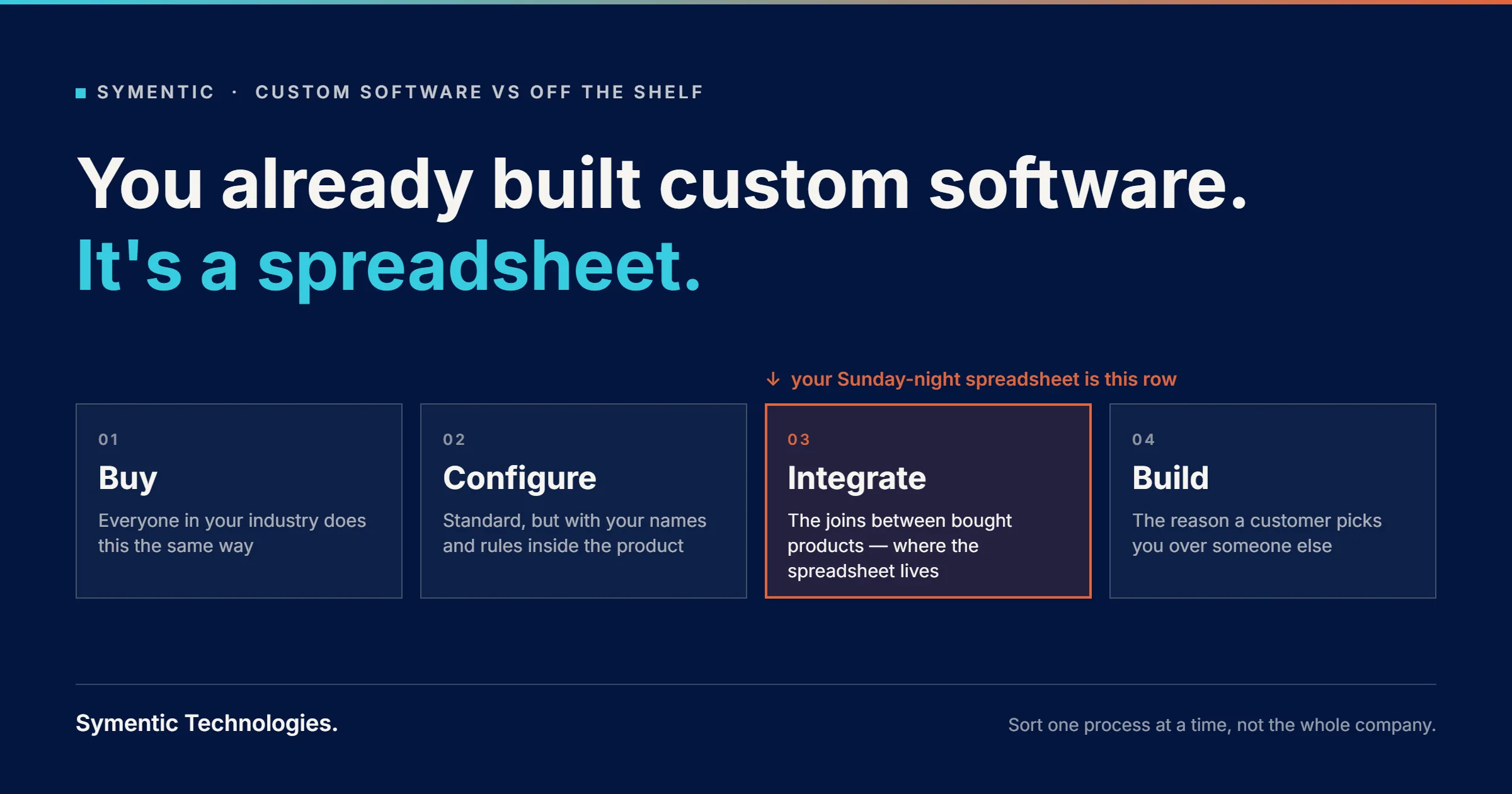
So stop sorting your business into custom software vs off the shelf and sort it into four.
Sort | The test that puts it here | What it costs you | How it fails |
|---|---|---|---|
Buy | Everyone in your industry does this the same way, and doing it differently would win you nothing | Subscription, escalating, forever | You wake up one day paying enterprise prices for a tool three people use |
Configure | Mostly standard, but needs your names, your rules, your workflow — inside the product's own settings | Setup time, then a slow tax on every upgrade | Configuration debt: so much bent into shape that you can never move, and the vendor's next release breaks the bending |
Integrate | The bought products are each right. The joins between them are what's missing — and the joins are where the spreadsheet lives | A small, boring build, and someone to keep it alive | Nobody owns it, so it rots silently until a Saturday |
Build | This is either the reason a customer picks you over someone else, or something no product covers because the market for it is too small | Real money up front, real money after | You build something you could have bought, beautifully |
Most businesses get the first and last rows right by instinct. Nobody sensible builds their own payroll, and nobody sensible outsources the thing they are actually good at. The mistakes live in the middle two rows — and overwhelmingly in the third.
The three questions that sort a process
Run each of these on one process at a time. Not on your company.
1. If a competitor did this exactly the way you do, would you lose anything?
If the honest answer is no, that process is context, not core. Buy it and stop thinking about it. Your payroll is not a competitive advantage no matter how elegantly you run it.
If the answer is yes — if the way you do this is why people choose you — then a product that makes you do it the standard way is not saving you money. It is quietly making you the same as everyone else, and charging you monthly for the privilege.
2. Is the process a workaround for the software, or is the software a workaround for the process?
This is the sharpest of the three. Watch the work.
If someone exports a report to make the software's output usable, the process is a workaround for the software — a sign you are in the wrong tool, or the right tool badly configured. If someone re-types a number that already exists in another system, that is not a tooling problem at all. That is a missing join, and it belongs in the integrate row. The distinction matters because the two have completely different fixes, and buying a replacement product fixes only the first one.
3. Where are the spreadsheets?
Every one of them is a seam your bought software doesn't cover. Map them before you buy anything: which systems does each one touch, who maintains it, and what breaks on the day they don't.
A word of warning on the tempting shortcut. It is easy to look at that list and conclude you need one system that does everything. The single-vendor suite is a real option and it solves the join problem by absorbing it. It also means every one of those escalating renewal lines now belongs to the same vendor, on the same date, with your entire operation as the hostage. We wrote separately about how you'd leave. Ask that question before you consolidate, not after.
The row nobody sells you
Integration is the largest category for most small businesses and the hardest to buy, for a simple structural reason: it is not a product. No vendor's marketing department exists to sell you the join between their software and their competitor's.
It is also the row where the government's own research lands. The Department for Business and Trade's SME Digital Adoption Taskforce, reporting in July 2025, found that digital products "often feel built for larger enterprises" and that for SMEs, "switching from one technology to another can feel too high risk." Both of those are descriptions of a business stuck between products that nearly fit — which is the integrate row, precisely.
The same report cites Enterprise Research Centre findings of "firm-level productivity improvements of 7 to 18 per cent per technology, depending on the product adopted", and a Be the Business estimate that lifting SME productivity by just one per cent over five years would add £94 billion a year to UK GDP. Read those two things together and the picture is a country full of businesses that bought the right software and never connected it.
What this looks like in practice is small and unglamorous. A hotel whose booking engine and channel manager each work correctly but don't agree about availability. A restaurant whose till, online ordering and accounts each hold a different version of yesterday. In both cases the answer is not a new product. It is a few hundred lines of code that nobody will ever write a case study about, and somebody to notice when it stops.
The bill for not doing it arrives as attention rather than as an invoice, which is why it never gets approved. A study of 20 teams — 137 people across three Fortune 500 companies, observed for up to five weeks — published in Harvard Business Review, found workers spending "just under four hours each week reorienting themselves after toggling" between applications — roughly 9% of their time at work. Those were enterprise employees with enterprise tooling. Your team is doing the same thing with a spreadsheet in the middle.
This is the work that most often justifies a small build in a business that should otherwise buy everything. It is cheap relative to replacing a system, it does not require anyone to change what they already use, and it deletes the spreadsheet.
Both roads pass through the same roadworks
There is one belief worth killing before you choose: that buying means the engineering stops.
It doesn't. It relocates — onto somebody else's timetable.
The example is on the calendar right now. Microsoft is retiring Exchange Web Services, the interface a great many business applications have used to talk to Outlook and Exchange for fifteen years. Per Microsoft's own documentation, EWS "starts to be disabled globally for all organizations" in October 2026 — next month — and is "fully disabled" in April 2027. Microsoft's instruction to customers includes working "with your vendors to prioritize their migration from EWS."
Nobody who depends on that chose the date. If a tool you bought uses EWS, you are now on a migration project you did not scope, in a quarter you did not pick, and your only lever is a support ticket. If a tool you built uses it, you are on the same project — but you can decide when, and what else to do while you're in there.
That is the honest shape of custom software vs off the shelf. Buying transfers the work, not the risk, and it transfers control of the schedule along with it. Building keeps the work and keeps the schedule. Neither one makes the roadworks disappear, and any supplier who implies otherwise — including one selling you a build — is selling.
What to do on Monday
List the spreadsheets. All of them, including the one on someone's desktop. For each: which systems it touches, who maintains it, what breaks without them.
List the software you pay for, with the annual cost and the renewal date. Most businesses cannot produce this list in under an hour, which is itself the finding.
Compound the total at 13.2% for five years. You now have the real number on the option you already chose.
Sort every process into four rows, using the three questions. One process at a time — custom software vs off the shelf has a genuinely different answer for payroll and for the thing you're known for.
Do the integrate row first. It is the cheapest, it needs no one to change what they use, and it produces a visible result in weeks rather than quarters.
Then look at what's left in the build row. If it is empty, you have saved yourself a project. That is a good outcome and you should take it.
Only then get quotes — and read them the way we'd read them, with the supplier's public record open in another tab.
Custom software vs off the shelf: the short version
Custom software vs off the shelf is a false binary, and no functioning business is on either end of it. Every business is a stack of bought products with something home-made in the gaps, and the only question worth asking is which layer you own, one process at a time.
The custom software vs off the shelf comparison tables mislead because they price the purchase and ignore the ownership. Off-the-shelf implementation runs one to three times the first-year licence, and the subscription rises around 13.2% a year — doubling in under six years, and costing about 30% more over five years than the flat sum you budgeted. Custom costs mostly after launch, which is a different problem and a more controllable one.
Sort each process four ways: buy it, configure it, integrate it, build it. Most small businesses get buy and build right by instinct and lose their money in the middle, particularly in integrate — the row nobody sells, where the spreadsheets live, and where the cheapest wins in the whole business usually are.
And whichever way you go, the engineering does not stop. Microsoft is switching off EWS next month. Nobody using it chose that date.
Not sure which row your problem is in? We are on both sides of the custom software vs off the shelf argument by construction: Symentic builds custom software for UK businesses, and we also sell two off-the-shelf products of our own, Stayvieo and FoodCiti. Which means we have told prospects to buy something instead of hiring us, and we have watched our own customers need a join we didn't build. If you send us your spreadsheet list we will tell you honestly which row each one is in — including the rows where the answer is "keep what you've got". See what we've built, or tell us what you're trying to do.
Related reading: Nobody can price your software from a blog post · Their portfolio is curated, their filing history isn't · Every supplier looks the same until you try to leave · A channel manager has never sold a room · You don't have a card rate, you have a card mix