Somebody in your business retypes invoices. A wholesaler's delivery note, a linen bill, a card machine statement, forty-odd supplier invoices a month, keyed into accounting software by a person who has better things to do. It is the most automatable job in a small business, which is why every software company on earth now offers to do it for you with AI.
Before you buy any of it, there is one thing worth knowing, and almost nobody in UK hospitality has heard it yet.
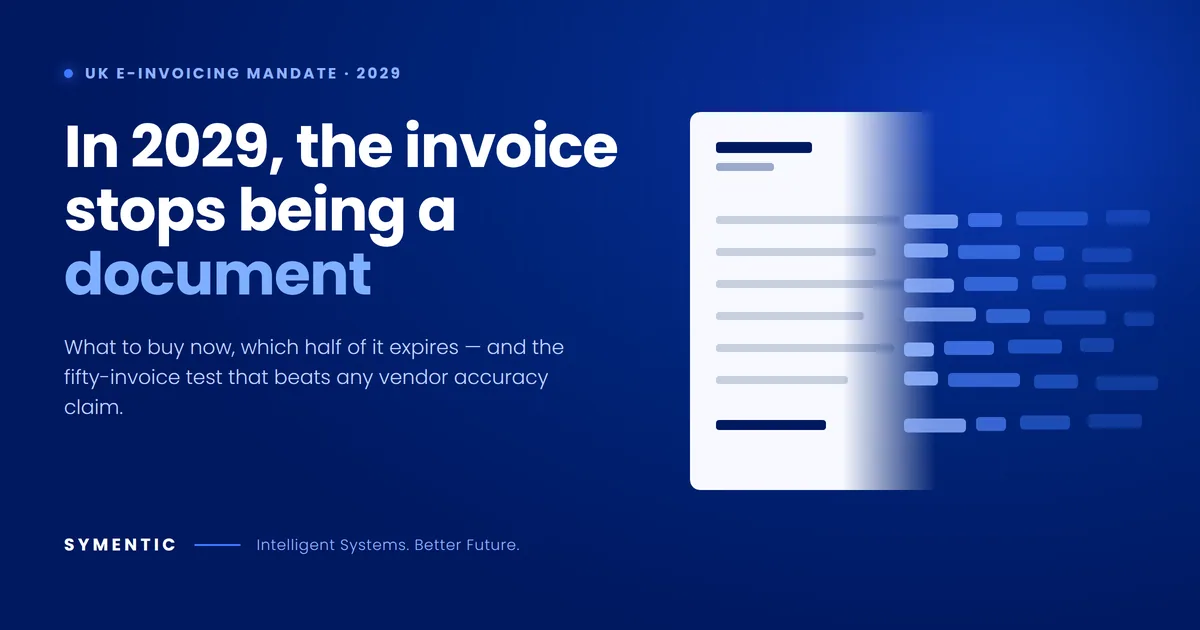
On 26 November 2025, the government published its response to the e-invoicing consultation. The decision: "the UK will introduce mandatory e-invoicing for all VAT invoices from 2029." B2B and B2G, decentralised rather than routed through a government platform, with an implementation roadmap promised at Budget 2026 — which the Chancellor has since confirmed for 28 October 2026. Six weeks from now.
Read that in terms of the thing on your desk. Today a supplier invoice is a picture of some data: a PDF, a scan, a photo of a docket taken in a stockroom. The entire extraction industry exists to turn that picture back into the data it was made from. From 2029, for VAT invoices, the data arrives as data.
That doesn't make invoice AI a bad purchase in 2026. You have three years of paper to get through and the roadmap isn't even published yet. It does change what you should buy — because roughly half of what these products do is a bridge, and bridges should be rented rather than owned. This post is about telling the half that expires from the half that doesn't, and about the one test that tells you whether any of it works on your invoices. That test takes an afternoon and fifty invoices you already have.
Part one: what you are actually paying for
The government's own case for e-invoicing is built on a statistic worth repeating, because it describes most small businesses precisely: industry data cited in the February 2025 announcement says 80% of businesses manually enter supplier data, and around 10% of it contains errors.
That announcement also puts a number on where the errors end up. "Failure to take reasonable care" and "error" accounted for 22% of the VAT tax gap in the 2022 to 2023 tax year. Not fraud. Typing.
So the cost of invoice data entry is not the hour a week. It's the hour a week, plus a tenth of the numbers being wrong, plus the fact that nobody finds out which tenth until an accountant or an inspector does. That is the case for automating it. It is also, precisely, the case for being careful about how.
Part two: what "extracting an invoice" actually means
Here is where most AI invoice tools are quietly demoed against the wrong standard.
A demo pulls four fields off a clean PDF: supplier, date, total, VAT. Impressive, fast, correct. Then you put it in front of your own post and discover HMRC's standard is not four fields.
HMRC's own manual lists the particulars a full VAT invoice must show. It runs to more than a dozen: a unique sequential number, the time of supply, the date of issue, the supplier's name, address and VAT registration number, the customer's name and address, a description of the goods or services, the quantity, the unit price, the rate of VAT and amount payable excluding VAT, the total amount payable excluding VAT, the total VAT chargeable, the rate of any cash discount, and a reference where a margin scheme or the reverse charge applies.
And crucially, several of those — the VAT rate, the amount excluding VAT, the quantity and the unit price — are required for each item on the invoice, not once for the document.
That single requirement is where hospitality lives. A restaurant's wholesale order is not one VAT rate. The dry goods are zero-rated, the soft drinks and confectionery are standard-rated, the cleaning supplies are standard-rated, and they arrive on one invoice with one total at the bottom. A tool that returns total £412.80, VAT £31.40 has read the invoice correctly and given you a number you cannot safely post. The rate mix is the whole job.
Two more edges worth knowing before you test anything:
Under £250 including VAT, a simplified invoice is legitimate and shows far less: supplier details, tax point, a description, and for each VAT rate the total payable including VAT plus the rate charged. Half your card-machine-era receipts are this. A tool that expects a full invoice layout will fail on them, and it will fail silently.
An invoice missing required particulars is an invalid invoice. HMRC's guidance on input tax treats an invoice as invalid where it lacks the regulation 14 requirements — including the customer's name and address, a description sufficient to identify what was supplied, and for each description the quantity and the rate and amount of VAT. An invalid invoice is a weak basis for an input tax claim, and a system that extracts confidently from one has simply given your error a tidier format.
The useful reframe: extraction is not a reading task, it is a validation task. The question is not "did it read the total" but "did it tell me this document is missing the customer address."
Part three: the arithmetic that vendor accuracy claims hide
Every extraction product quotes an accuracy figure. Almost all of them quote it per field, and every business that buys one cares per invoice.
Those are different numbers, and the gap is larger than intuition suggests.
Say a tool is right 97% of the time on any given field, and you need eight fields to post an invoice without a human touching it. The probability all eight are right on the same invoice is 0.97 multiplied by itself eight times: 78%.
Per-field accuracy | 5 fields right | 8 fields right | 13 fields right |
|---|---|---|---|
99% | 95% | 92% | 88% |
98% | 90% | 85% | 77% |
97% | 86% | 78% | 67% |
95% | 77% | 66% | 51% |
90% | 59% | 43% | 25% |
(That multiplication assumes the fields fail independently, which is a simplification in both directions — a bad scan wrecks everything at once, while a good model rarely misreads a total and a date on the same clean page. Treat the table as the shape of the problem, not a forecast.)
Two things follow.
A "97% accurate" tool means roughly one invoice in five needs a human. That's not a scandal — it's a perfectly good outcome, and far better than typing all of them. But it is a very different purchase from the one the number implies, and it means your review queue is not an edge case, it's the main workflow. Design for it or the feature dies in month two.
Adding fields is expensive in a way nobody prices. Going from five fields to thirteen at 97% takes you from 86% to 67% of invoices clean. If you want line-level VAT rates — and part two says you do — you are asking for the right-hand column.
We made the same argument about AI agents from the other end: an agent that passes a test once has only proved it can do the job once. The invoice version is simpler and more immediate. One run, many fields, all of which have to be right at the same time.
Part four: the afternoon test
Do not buy invoice extraction on a demo. A demo is someone else's invoices.
Here is the test we run, and the one we'd run before quoting anyone for a build. It takes an afternoon and it needs no engineering.
Take fifty real invoices from last month. Not your cleanest fifty. Take them in the order they arrived, including the photographed one, the handwritten delivery note, the one that came as four pages stapled into a PDF the wrong way round, and the ones from the three suppliers who change their template without telling anyone. If your post is 20% ugly, the test should be 20% ugly.
Decide your field list first, and write it down. Whatever you need to post the invoice without opening it again. For most kitchens that is supplier, invoice number, date, net, VAT per rate, gross, and nominal code.
Run all fifty through whatever you're evaluating — including the free trial of the tool the vendor is pitching, and including a general-purpose AI assistant with your field list as the instruction, which is a genuinely useful baseline.
Then score it as a table, one row per invoice, and record four things:
What to record | Why |
|---|---|
Every field correct? Yes / No | This is the only accuracy number that matters. Not fields right out of 350 — invoices right out of 50. |
Which field failed | If it's always the same field on the same supplier, that's a mapping job, not an AI problem, and it's cheap to fix. |
Seconds to check and correct | The real saving is typing time minus checking time. A tool that is 95% right but takes 90 seconds to verify has saved you nothing. |
Did it fail loudly or quietly? | The most important column. A tool that says "I can't read the VAT breakdown" is safe. A tool that confidently invents a plausible total is a liability, and you will only catch it in this test if you check every row. |
Then apply the decision rule. Invoices fully correct out of fifty, multiplied by your monthly invoice volume, times the minutes each currently takes, minus the checking time on all of them. If that number isn't obviously worth the subscription and the setup, the honest answer is to keep typing and revisit when the 2029 roadmap lands.
Almost nobody runs this test, which is why so many businesses own an extraction tool that somebody quietly stopped using. It is also, not coincidentally, the same shape as the 30-day test we recommend for any AI feature: count first, measure against the number you wrote down, and be willing to conclude no.
Part five: don't rebuild a copy-paste
If the test passes and you automate, there is one rule about where the data goes, and it is not optional in the way people assume.
HMRC's Making Tax Digital notice is explicit: "A digital link is where a transfer or exchange of data is made (or can be made) electronically between software programs, products or applications", and "HMRC does not consider the use of 'cut and paste' or 'copy and paste' to select and move information, as a digital link."
So an extraction tool that produces a screen someone reads and retypes into your accounts has automated the reading and left the compliance problem exactly where it was. It has also, in fairness, left most of the labour there too. The output has to land in the system by a link, not by a human hand.
This matters to more businesses this year than last. From 6 April 2026, sole traders and landlords with qualifying income over £50,000 are in Making Tax Digital for Income Tax — digital records, compatible software, quarterly updates. HMRC has also said it will automatically sign up eligible people from September 2026 where their 2024–25 qualifying income was over the threshold. A good number of guest house owners, single-site operators and takeaway proprietors are sole traders above £50,000, and this is the first year their bookkeeping method is a legal question rather than a preference.
Part six: which half of the purchase survives 2029
Back to the mandate, because it is the only part of this post that is about three years from now and it should change what you sign today.
The consultation response is clear that this is not an immediate real-time reporting regime: "RTR will not be implemented in 2029 but would be implemented once e-invoicing use was well established." It is also clear that the smallest businesses are not being dragged in — "many of the smallest businesses who are not required and choose not to be registered for VAT will not be obliged to adopt this technology." And the standards work is live rather than settled: the government says it will "develop e-invoicing standards which enable interoperability and balance flexibility and simplicity", with the roadmap at Budget 2026.
Which means the sensible way to buy in 2026 is to split the purchase in two.
The part that expires is the reading. Optical extraction, template training, layout matching, the clever bit that handles a photograph of a docket. Valuable now, less valuable each year, mostly irrelevant for VAT invoices once your suppliers are sending structured data. Rent it. Short contracts, no bespoke engineering, no data trapped inside it.
The part that doesn't expire is everything downstream. Your supplier list mapped to your nominal codes. Your VAT rules for the lines you buy. The review queue and who watches it. The rule that flags an invoice 30% above the last one from the same supplier. The audit trail. Six years of records — VAT records must be kept for at least six years, and HMRC accepts an image in place of the original where "the image is retained and contains all the detail required for VAT purposes", with a few exceptions such as the C79 import VAT certificate, which must be kept in its original form.
None of that second list cares where the data came from. It works identically whether the invoice arrived as a photo in 2026 or as a structured message in 2030. That's the half worth building properly and owning.
Which is the same test we apply to every supplier: what leaves with you if the relationship ends on Friday. For an extraction tool, the answer should be — the structured data, the supplier mappings, the corrections your staff have made for two years, in a format you can use. If it isn't, you are renting the reading and giving away the part that was actually accumulating value.
The short version
The UK will mandate e-invoicing for all VAT invoices from 2029, and the roadmap arrives at Budget 2026. Before then you still have a room full of PDFs, and AI extraction is a reasonable way to deal with them.
Buy it knowing three things. HMRC's standard is more than a dozen particulars with the VAT rate required per line, not four fields and a total, which is why mixed-rate wholesale invoices break most tools. Per-field accuracy is not per-invoice accuracy, and at 97% per field across eight fields roughly one invoice in five still needs a person. And the output has to reach your accounts by a digital link, because copy and paste is explicitly not one.
Then run the test. Fifty of your own invoices, one afternoon, one honest number. It is worth more than any vendor's accuracy claim, including ours.
Working out what to automate first? We build AI features into software UK hospitality businesses actually run on, and we are equally willing to tell you a tool isn't worth the subscription. Run the test in part four and send us the result — the number of invoices out of fifty that came back fully correct tells us more in one line than a scoping call does in an hour. See what we've built, or tell us what you're trying to do.
Related reading: AI that pays for itself: what actually works in small business software · Most AI vendor checklists ask you to verify things you can't · Your agent passed. That only proves it can do the job once · Every supplier looks the same until you try to leave