There is a genre of article aimed at anyone about to hire an AI firm. You have probably read four of them this month. They are nearly identical, and they are nearly always written by an AI firm.
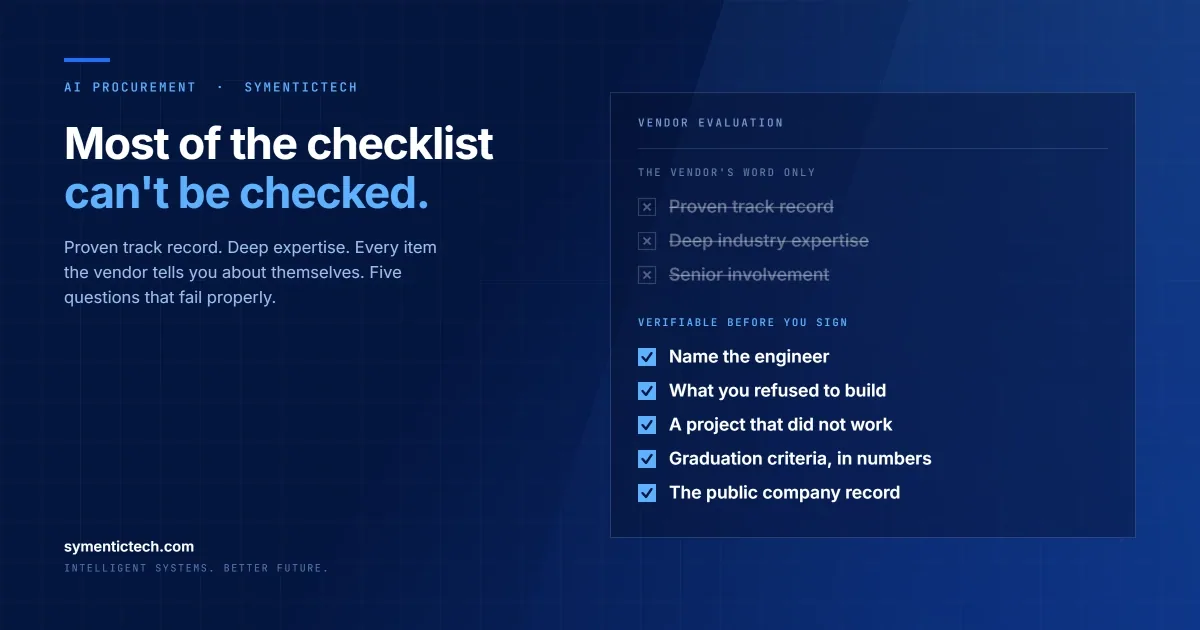
The advice is consistent. Look for a proven track record. Look for deep industry expertise. Look for a transparent development process and a focus on measurable business outcomes. Look for senior involvement throughout the engagement.
Read that list again as a buyer sitting across from a vendor who wants your signature. Every item on it is something the vendor tells you about themselves. Not one of them is a thing you can independently check before money changes hands.
That is not an accident. Unfalsifiable criteria are comfortable for both sides of the table. The buyer feels like they ran a process. The vendor answers yes to everything, because there is no answer that fails. Six months later the project has not shipped and nobody can point to the moment where the evaluation went wrong — because the evaluation never tested anything.
What follows is the smaller list. Fewer questions, all of them checkable at the sales stage, most of them checkable before you take a second meeting.
1. Who is going to write this, and can I talk to them for thirty minutes?
Not "can I meet the team." The specific individual who will be in your codebase, by name, in a call before you sign.
The person selling to you is frequently not the person who will build for you. This is normal in professional services and it is not inherently dishonest. It becomes dishonest when the technical depth you evaluated during the sales cycle walks off the project the week after kickoff and is replaced by whoever was on the bench.
This question is verifiable because it either happens or it does not. If the named engineer cannot be produced for half an hour before contract, one of two things is true: they are not assigned to you, or they do not exist yet and will be hired against your budget. Both are useful to know in week zero rather than week nine.
2. What have you talked a client out of building?
Ask for a specific instance. What did they want, what did you say, what did you build instead.
This is hard to fake convincingly because a real answer contains details a made-up one does not — the original request, the reason it was wrong, the client's reaction, what shipped in its place. Vendors who have never done this will produce something abstract about "challenging assumptions."
The reason it matters: a firm that has never told a client no is a firm that bills for whatever the client asks for. In AI work that is expensive, because a meaningful share of what clients initially ask for is either technically infeasible on their data or solvable without a model at all. You want the firm that says so in week one, not the one that discovers it in month four and invoices for the discovery.
3. Tell me about one that did not work.
Every vendor has case studies. Case studies are marketing artifacts and should be read as such.
Ask instead for a project that failed, what it cost, and what they changed internally afterwards. The last clause is the real question. Anyone can produce a war story. Fewer can name the specific change in how they scope, staff, or test that resulted from it.
If the answer is that nothing has failed, you are talking to someone who is either very new or not being straight with you. Neither is what you want on a system that will sit in your operations.
4. Write the graduation criteria before you write the statement of work.
Ask the vendor to define, in numbers, what "this is working" means — before the commercial terms are agreed.
A pilot without an exit condition does not end. It gets extended, rescoped, and eventually absorbed into a maintenance retainer that nobody remembers approving. The way you prevent that is to fix the threshold while both parties still have an incentive to be honest about it: the vendor wants the deal, so they will engage seriously, and you have not yet spent anything, so you can walk.
We have written about scoping a pilot around its graduation criteria at more length. The short version is that a threshold agreed after the contract is signed is a threshold the vendor has every reason to set low.
This is verifiable in the most direct way available: either they can write it down or they cannot.
5. Look them up in the public record.
Four minutes, no meeting required, and it is the only item on this list that does not depend on the vendor's cooperation.
Company registration number. Date of incorporation. Registered address. Named directors. Filed accounts, if the jurisdiction requires them and enough time has passed. In the UK this is Companies House. Most jurisdictions have an equivalent and most of them are free.
You are not looking for anything dramatic. You are checking that the entity is what the website implies it is: incorporated when they say, where they say, run by the people whose faces are on the about page. A firm presenting a decade of experience through a company registered fourteen months ago is not necessarily lying — people leave firms and start new ones constantly — but it is a discrepancy worth one direct question.
The reason this belongs on the list is not that fraud is common. It is that a supplier who will hold your operational data should be a legible legal entity, and confirming that is the cheapest diligence available to you.
The part that applies to us as well
We are an AI firm publishing a guide on evaluating AI firms, which puts this article in exactly the genre it opened by criticising. The honest response is to accept the same test.
So: SymenticTech will name the engineer before contract and put them on a call. We will write graduation criteria into the scoping document rather than the statement of work. We are happy to describe a project that did not work and what we changed because of it.
And on the fifth item — if you look us up and find less public record than you expected, that is a fair observation and we would rather you raise it than quietly deprioritise us. We are a young company. The registration is real, the work is real, and we would rather be checked than taken on trust.
That is the whole point of the list. A vendor who is happy to be verified is telling you something. A vendor who steers you back toward proven track record and deep industry expertise is telling you something too.
SymenticTech builds and operates AI systems for businesses. If you are scoping an AI project and want a second opinion on whether it should exist, get in touch.