In July the Office for National Statistics published three years of data on how UK businesses use artificial intelligence. Among the smallest firms, those with nine staff or fewer, 28% now report using at least one AI technology. And when businesses were asked what was stopping them, the answer at the top of the list was not cost and it was not fear. It was "difficulty identifying business use cases".
That is the honest position on AI for small independent hotels and guest houses. The tools are cheap, the demos are impressive, and nobody can say with any confidence which part of running a 12-room property they should actually be pointed at.
So this post does not argue for or against AI for small independent hotels. It goes through the five jobs AI is most often sold for in a small hotel, says roughly what each is worth, and applies one test to all of them — the test that decides whether a tool saves you time or quietly creates a liability.
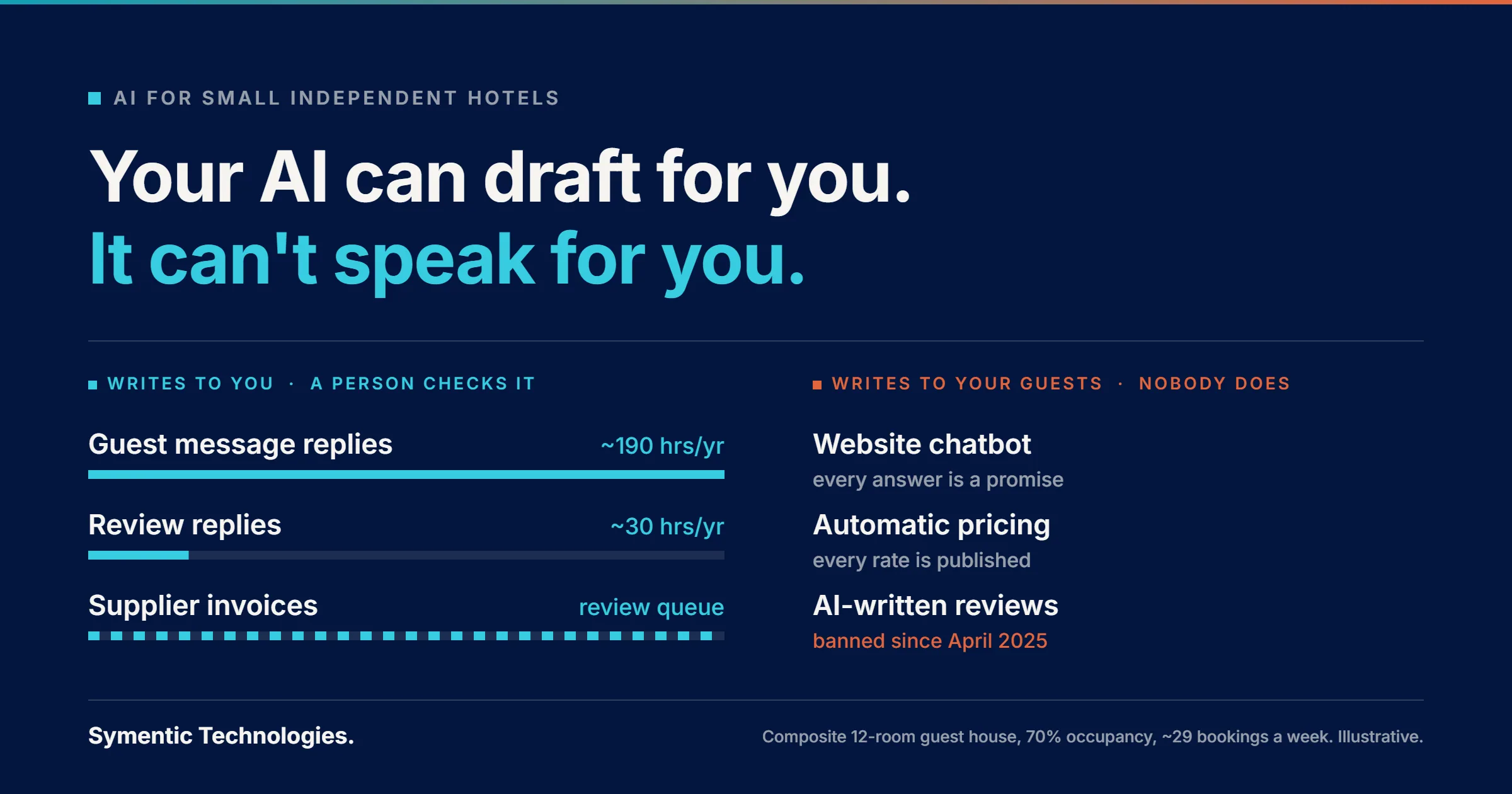
The test is this: is the output a draft that a person reads and sends, or is it a statement your hotel makes?
A draft costs you nothing when it is wrong, because somebody catches it. A statement is yours the moment it leaves the building, whoever — or whatever — wrote it.
The numbers below are a composite, not a client: a 12-room guest house at 70% occupancy with an average stay of two nights. That works out at about 29 bookings a week.
Job 1: Drafting replies to guests — the best payback, if a person presses send
Every booking generates messages. Is there parking? Can we check in at nine? Is the room on the ground floor? Do you do gluten-free breakfast? Call it three messages per booking, before, during and after the stay — about 88 messages a week.
Written from scratch at four minutes each, that is nearly six hours a week of somebody's time, usually squeezed between check-outs and the laundry. With an AI drafting the reply from your own information and a person reading, correcting and sending it in about a minute and a half, it falls to just over two hours. The saving is around 3.7 hours a week, or about 190 hours a year — close to five working weeks.
That is the largest single saving on this list, and it is real. It is also where the most important rule lives, so it is worth being precise about why it works.
It works because the AI is writing to a person, not to the guest. The owner reads every reply before it goes. The AI never has to be right; it only has to be close enough that correcting it is quicker than writing from nothing.
Now take the person out. Send the drafts automatically and those 88 messages a week become about 4,600 a year, each one a statement from your hotel. At a 1% error rate — generous for a system answering questions about your cancellation terms from memory — that is roughly 46 wrong answers a year, sent in your name, to guests who will act on them.
What does one wrong answer cost? There is a case that answers that exactly.
The chatbot that invented a refund policy
In November 2022, a man named Jake Moffatt used the chatbot on Air Canada's website to ask about bereavement fares after his grandmother died. The chatbot told him he could book a full-price ticket and apply for the bereavement discount retroactively. That was not Air Canada's policy. When he applied, the airline refused.
He took it to British Columbia's Civil Resolution Tribunal, and in February 2024 he won. Air Canada's defence is the part every hotel owner should read. The tribunal recorded it like this:
"Air Canada suggests the chatbot is a separate legal entity that is responsible for its own actions. This is a remarkable submission. While a chatbot has an interactive component, it is still just a part of Air Canada's website."
And then the sentence that ended the argument: "It should be obvious to Air Canada that it is responsible for all the information on its website."
The tribunal found that "the applicable standard of care requires a company to take reasonable care to ensure their representations are accurate and not misleading", and that Air Canada had not. The airline had argued the correct policy was available elsewhere on its site. The tribunal was unmoved: Air Canada "does not explain why the webpage titled 'Bereavement travel' was inherently more trustworthy than its chatbot."
The award was small, a little over C$800. The principle is not. It is a Canadian tribunal decision and it does not bind a UK court, but it is the clearest statement anywhere of what common sense already tells you: you cannot outsource responsibility for what your business says to the software that said it. Nothing in UK consumer law suggests a guest would get a worse hearing here.
The rule for guest messaging: AI drafts, a person sends. Anything that touches money — cancellations, refunds, deposits, no-show charges, prices — is never answered automatically, full stop. And the AI drafts from your written policies, not from what it thinks hotels usually do. If your cancellation terms are not written down somewhere it can read, that is the first job, and it has nothing to do with AI.
Job 2: Replying to reviews — useful, with a legal line you must not cross
A property with 29 bookings a week and a 30% review rate gets about nine reviews a week across Google, Booking.com and TripAdvisor. Replying well takes time, especially to the bad ones, where the temptation is to write something you regret. An AI that drafts a calm, specific first version is worth having. At six minutes a reply down to two, it saves about 30 hours a year — modest, but it also tends to make replies more consistent and less defensive, which is its real value.
This is a draft job, and it passes the test. But the same tools will happily do something else, and since April 2025 that something else is illegal in the UK.
The Digital Markets, Competition and Consumers Act 2024 added a banned practice to consumer law: "Submitting, or commissioning another person to submit or write— (a) a fake consumer review". A fake review is defined as "a consumer review that purports to be, but is not, based on a person's genuine experience". An AI-written five-star review of your own guest house is a textbook example — there is no person, and no experience.
The CMA's guidance for businesses also targets the quieter version, "concealed incentivised reviews", and gives an example that could have been written for this sector: an incentive can be "money or other benefits, like a free stay at a hotel or another 'freebie'". Offering a discount on the next stay in exchange for a review, without that being disclosed, is on the wrong side of the line.
These are not polite suggestions. Under the same Act, the CMA can now fine a business directly, up to "£300,000 or, if higher, 10% of the total value of the turnover" of the business concerned.
The rule for reviews: AI may write your reply to a review. It may never write a review, and it may never help you ask for one in exchange for something you are not disclosing.
Job 3: Supplier invoices and the back office — dull, and worth it
Laundry, food, cleaning supplies, utilities, the plumber. A small hotel's back office is mostly reading other people's invoices and typing them into something. AI extraction does this well, it is invisible to guests, and every output lands in a review queue before it touches the accounts — the definition of a draft.
We have written about this at length, including the test to run on fifty of your own invoices before you buy anything, and why the UK's move to mandatory e-invoicing from 2029 changes what is worth paying for now. The short version: it is one of the safest places a small property can start, precisely because nobody outside the building ever sees its mistakes.
The rule for the back office: keep a person approving the batch, and check that the thing you buy can export your data when you leave.
Job 4: The chatbot on your website — the one to be most careful with
This is the job AI is most often sold for in hospitality, and it is the one that fails the test by design. A website chatbot has no draft stage. Every answer is a statement from your hotel, to a guest, the instant it is generated. It is exactly the arrangement Air Canada had.
That does not mean never. It means a chatbot for a small hotel should be built narrowly:
It answers only from pages you have written — your FAQ, your policies, your room descriptions — and says "I don't know, here's how to reach us" when the answer is not there. A chatbot that fills gaps from general knowledge will eventually invent a policy.
It never quotes a price or a cancellation term in its own words. It links to the page, or to the booking engine, where the real price lives. Prices belong to the booking engine, which is the one box on your site that actually sells a room.
It hands off to a person for anything involving money, complaints or special requests. Not as an option buried at the bottom — as the default.
Every conversation is logged, so when a guest says "your website told me", you can see what it told them.
And ask yourself honestly whether you need it. A 12-room property whose FAQ page is clear and whose inbox is answered within a couple of hours may get more from Job 1 than Job 4, with none of the exposure.
The rule for chatbots: if you cannot say exactly which pages it is allowed to answer from, it is not ready to talk to guests.
Job 5: AI pricing — oversold for a property this size
Revenue-management tools that "set your rates with AI" were built for hotels with hundreds of rooms and years of booking history. A 12-room guest house has neither. It sells about 59 room-nights a week, and its demand is driven by things a model cannot see well: the wedding at the venue down the road, the school holidays, the road works on the A-road.
Suggestions are fine. A tool that shows you what comparable properties nearby are charging this weekend, and flags a date where you are well below the market, is useful information for a person to act on. Autopilot is a different thing. A price published to Booking.com and your own site is a statement your hotel makes, to every guest at once, and a pricing model with thin data can be confidently wrong across a whole week before anyone notices.
The rule for pricing: let it advise, and keep a person setting the rate — at least until you have seen, over a season, whether its advice would have made you more money than your own judgement did.
The part nobody mentions: whose computer your guests' details are on
Every one of these jobs involves feeding the AI information — often guest names, emails, booking details, dietary and access needs. Pasting that into a free chatbot account on a personal login is the most common way small hotels start using AI, and it is the one worth stopping.
Under UK GDPR, when another company processes personal data on your behalf, you "shall use only processors providing sufficient guarantees" to protect it, and the arrangement "shall be governed by a contract" setting out what they do with it. A personal account on a consumer tool, where the terms may allow your inputs to be used to improve the service, is rarely that.
The fix is not complicated: use a business tier with a proper data processing agreement, turn off training on your data where the option exists, and keep the most sensitive details — health and access needs above all — out of anything that does not need them. Whoever builds your system should be able to tell you in one sentence where the guest data goes. If they cannot, treat that as an answer.
AI for small independent hotels: the five jobs side by side
Job | Draft or statement? | Rough value (composite 12-room property) | The rule |
|---|---|---|---|
Guest message replies | Draft — if a person sends | ~190 hours a year | AI drafts, a person sends; nothing about money goes out automatically |
Review replies | Draft | ~30 hours a year, plus calmer replies | AI writes replies, never reviews; no undisclosed incentives |
Supplier invoices | Draft — review queue | Depends on volume; test on 50 invoices first | A person approves the batch; check the export |
Website chatbot | Statement, always | Depends on inbox volume; often less than job 1 | Answers only from your pages; hands off on money and complaints; logs everything |
Rate setting | Statement, once published | Uncertain at this size | Advise, don't autopilot |
The pattern is obvious once it is on one page. The jobs that pay back fastest are the ones where the AI writes to you. The jobs that carry the risk are the ones where it writes to your guests.
Four questions to ask before you buy an AI tool for your hotel
Where does a person see the output before a guest does? If the honest answer is "nowhere", you are buying a spokesperson, not an assistant. Decide if that is what you want.
What does it answer from? Your own written policies and pages — or its general idea of what hotels do? Ask to see what happens when you ask it something that is not in your material.
Run the same question ten times. Is the answer the same every time? A tool that is right most of the time and different each time is not reliable enough to talk to guests. We explain why a single good demo proves very little.
Where do my guests' details go, and is there a contract that says so? A supplier who has built this properly can answer in a sentence.
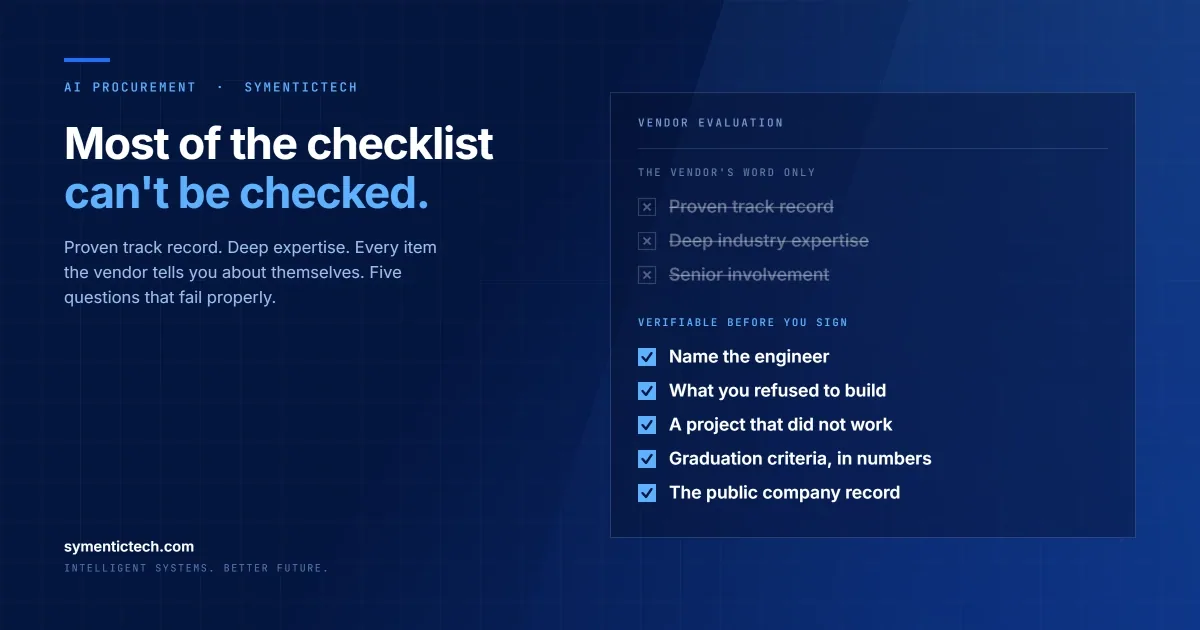
For a longer checklist, there is our guide to evaluating AI vendors, and for the wider case for where AI pays in a small business, AI that pays for itself.
The short version
For a small independent hotel, the useful AI is mostly unglamorous. Drafting guest replies is worth about five working weeks a year on a 12-room property. Drafting review replies and reading supplier invoices are smaller wins but safe ones. All three work because a person reads the output before anyone else does.
The website chatbot and automatic pricing are where the exposure is, because there is no draft stage — every output is a statement your hotel makes. Air Canada argued its chatbot was responsible for its own words and a tribunal called that "a remarkable submission". UK law has made AI-written reviews of your own business a banned practice, with fines of up to 10% of turnover.
So before you switch anything on, ask the one question that sorts every AI tool into the right pile: is this writing to me, or writing to my guests?
Running a small hotel and wondering which of these is worth it for you? We build and run Stayvieo, hospitality software for independent UK hotels and guest houses, and we build AI systems for small businesses with a person in the loop by default. Run the four questions above on us before you take our word for anything, and check us the way you'd check any supplier. See what we've built, or tell us what your inbox looks like on a Monday morning.
Related reading: AI that pays for itself · Your agent passed. That only proves it can do the job once · In 2029, the invoice stops being a document · Booking engine vs channel manager