Two numbers tell you almost everything about the state of AI in small business right now.
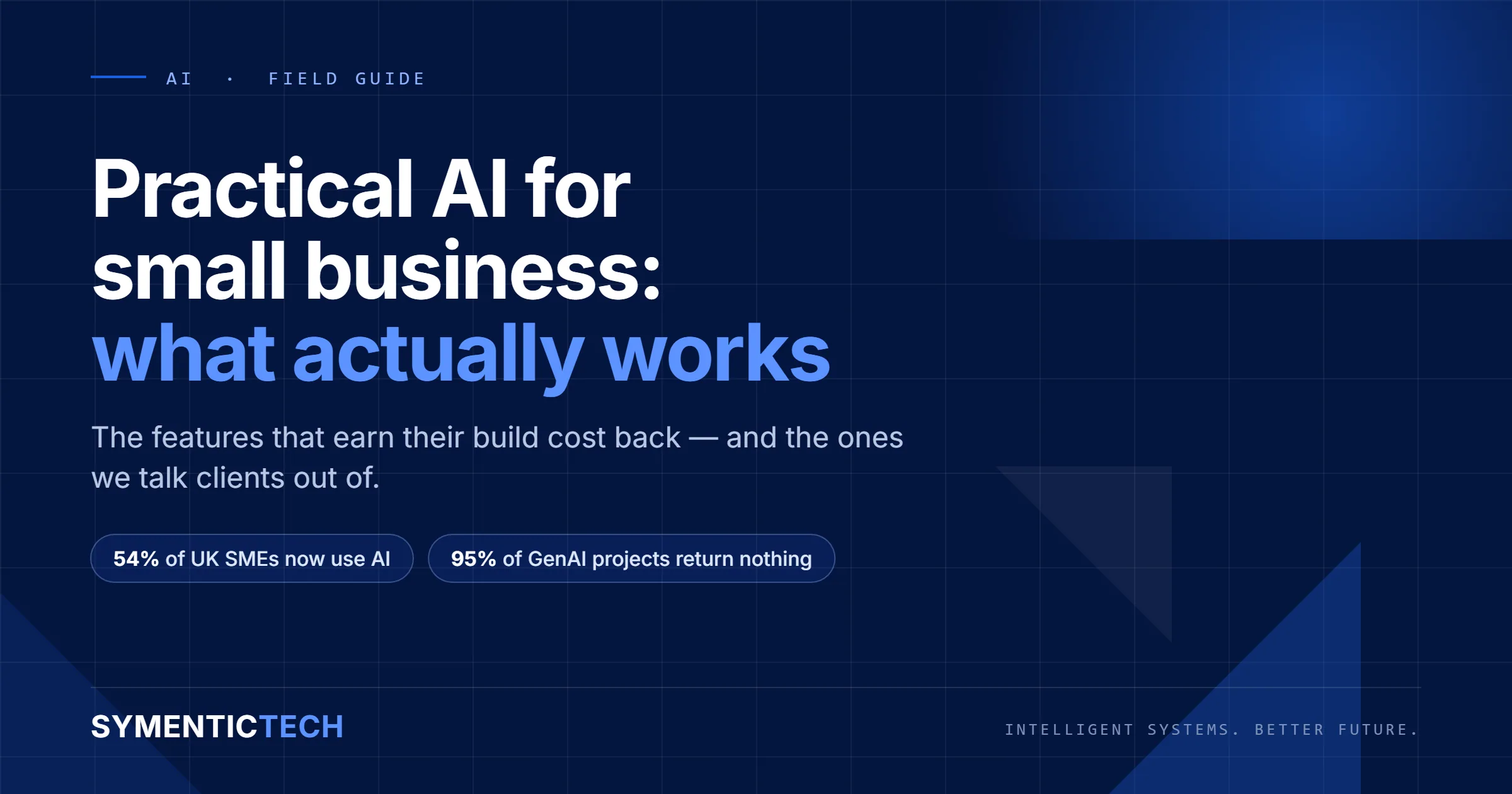
The first: 54% of UK SMEs actively adopted AI in 2026, up from 35% the year before and 23% in 2023, according to research by the British Chambers of Commerce with Atos. Adoption is no longer a question. It has happened.
The second: MIT Media Lab's Project NANDA, in The GenAI Divide: State of AI in Business 2025, found that roughly 95% of generative AI projects produced no measurable business return. Only about 5% of integrated pilots were extracting real value.
Put those together and you get the actual problem. Almost everyone is buying. Almost nobody is getting paid back.
We build software for independent hotels, guest houses, restaurants and takeaways, and we run two platforms of our own — Stayvieo for hospitality and FoodCiti for food ordering. So we have shipped AI features into products that real businesses run on, and we have also quietly killed a few that looked great in a demo and did nothing in production. What follows is a practical guide to AI for small business owners: which features earn their build cost back, which don't, and how to tell the difference before you spend anything.
Why most small business AI spend disappears
The MIT research is blunt about the root cause, and it is not the one most people expect. It is not a lack of infrastructure, and it is not a shortage of talent. It is that the systems do not learn the business. They have "brittle workflows, weak contextual learning, and misalignment with day-to-day operations." They forget context. They do not improve. They sit next to the work instead of inside it.
For a small business the failure looks more mundane. Someone buys a tool with "AI" on the box. It lives in a separate tab. Using it requires copying something out of the system you actually work in, pasting it somewhere else, reading the output, deciding whether it is right, and pasting it back. That is four steps of human labour added to save one. Two weeks later nobody opens the tab.
The pattern is consistent enough to state as a rule: AI creates value when it removes a step from a workflow someone already performs, and destroys value when it adds one.
The three-part test before you build anything
Before we agree to build an AI feature for a client, we put the idea through three questions. If it fails any of them, we say so.
1. Is the task genuinely repetitive and high-volume? A takeaway that receives 200 order-related messages a week has a real problem worth automating. A consultancy that sends four proposals a month does not — the setup cost will never be recovered. Count the actual occurrences per week before you do anything else.
2. Is a wrong answer cheap to catch and fix? This is the one people skip. AI output should land somewhere a human sees it before it becomes consequential. Drafting a reply for a manager to approve is safe. Automatically issuing a refund is not. Where mistakes are expensive and invisible, the feature needs a different design or should not exist.
3. Does the output go somewhere structured? Free-form text that a person still has to interpret is where most of the value leaks out. When a model returns a defined shape — a category, a date, a set of fields your database already understands — the rest of your system can act on it. We use OpenAI with structured output for exactly this reason: it turns AI from a writing tool into a component you can build on.
Five AI jobs that reliably pay for themselves
These are the patterns we see earn back their build cost fastest in small business software — and they are the ones we recommend most often when we scope AI implementation for small business clients in the UK, particularly in hospitality and food service.
1. Turning messy inbound into structured records
Enquiries arrive as unstructured mess: a WhatsApp message about a room for "the weekend after next," an email with dates buried in the third paragraph, a voicemail transcript. A human reads it and types the details into a system.
That reading-and-retyping step is the single best AI target in most small businesses. A model reads the message and returns dates, party size, contact details and intent as structured fields, pre-filled into your booking or enquiry form. The human checks and confirms rather than transcribes. It removes a step instead of adding one, mistakes are visible immediately, and the output is structured. All three tests pass.
2. AI document extraction: invoices, menus and supplier paperwork
Supplier invoices, delivery notes, allergen sheets, third-party booking confirmations, PDF menus from a new partner restaurant. Small businesses receive a steady stream of documents that someone keys in by hand.
Document extraction is mature, reliably accurate on standard formats, and the payback is easy to calculate: hours per week of manual entry, multiplied by whatever those hours cost. When we onboard a restaurant onto FoodCiti, turning their existing menu into structured items and modifiers is exactly this job — and it is the difference between onboarding taking twenty minutes and taking an afternoon.
3. Drafting the writing that repeats
Booking confirmations, review responses, order-issue replies, follow-ups to enquiries that went quiet. Not creative writing — the repetitive, semi-templated writing that is too varied for a fixed template but too routine to deserve real thought.
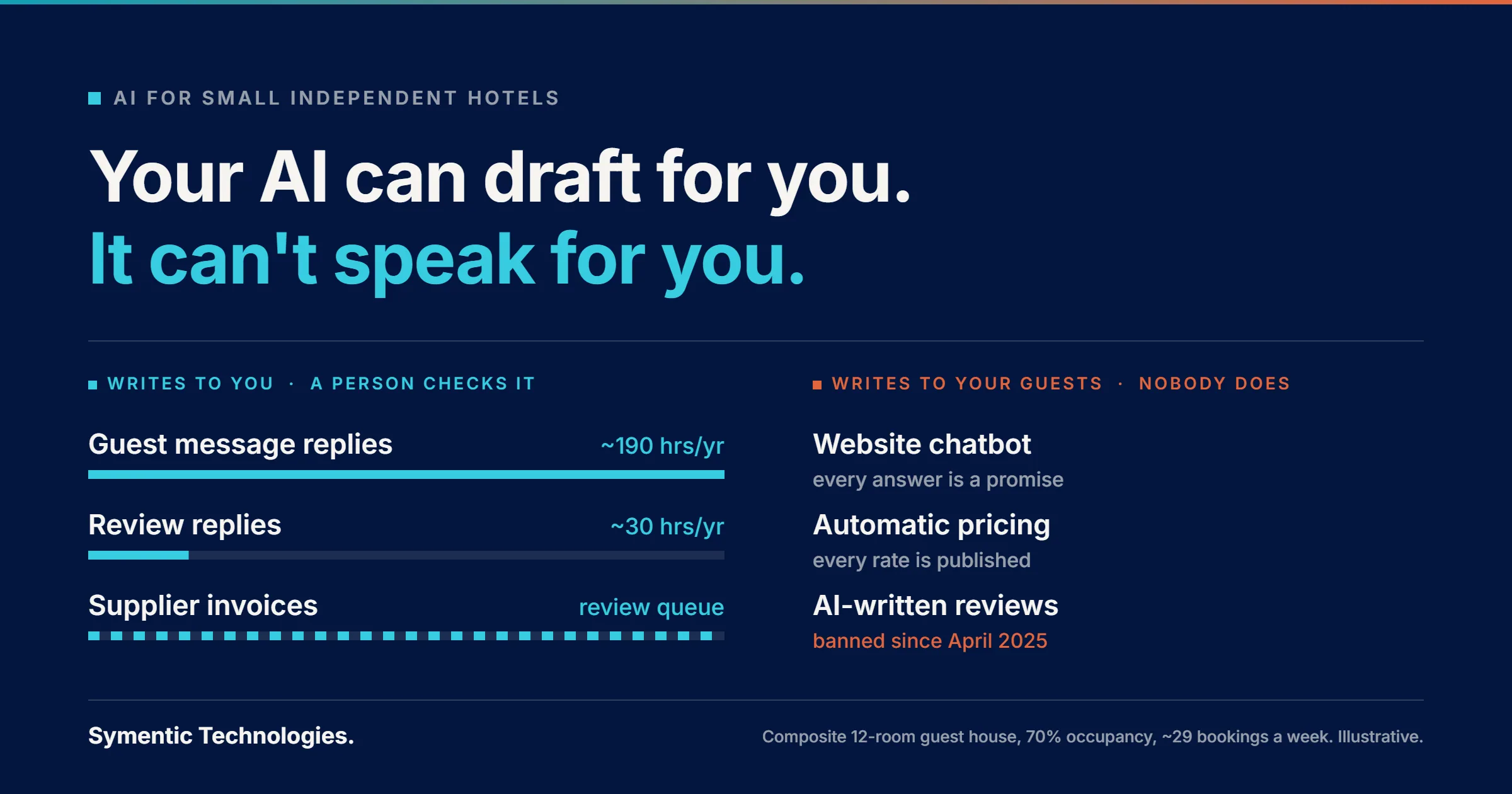
The critical design choice is that AI drafts and a human sends. That single constraint keeps the failure mode cheap, keeps the business's voice intact, and keeps the feature useful even when the draft is 80% right. Teams that skip approval to save a click usually end up switching the feature off within a month.
4. Search that understands the question
Small businesses accumulate scattered knowledge: house rules, cancellation policies, dietary information, "what did we tell that guest last time." Traditional keyword search fails because staff and customers ask in natural language rather than in the words the document happens to use.
Semantic search over your own content is a contained, low-risk feature with a clear success measure — do people find the answer without asking a colleague? It also quietly reduces the interruptions that eat a small team's day.
5. Categorisation and routing at volume
Which of today's 60 messages are complaints, which are new bookings, which are suppliers, which can wait until tomorrow. Classification is one of the oldest and most dependable things models do well, and it is close to invisible when it works — which is exactly why it is undervalued. Nobody demos a triage queue. Everybody benefits from one.
Three that usually don't pay off yet
We will talk clients out of these more often than not.
Fully autonomous customer conversations. An AI that handles a customer end-to-end without oversight looks like the biggest saving on paper. In practice, in a business whose reputation is local and personal, one confidently wrong answer about an allergen or a cancellation policy costs more than a year of saved staff minutes. Assist your team; do not replace the conversation.
AI-generated content at scale. Volume publishing produces material that ranks poorly, reads generically and, in a hospitality business, actively undercuts the thing customers are buying — that a real person runs the place. The economics stopped working a while ago.
Prediction on thin data. Demand forecasting, dynamic pricing and churn prediction are genuinely valuable, but they need history. A guest house with fourteen months of bookings does not have enough signal for a model to beat a sensible rule and an experienced owner's judgement. Build the data collection now; build the prediction in two years.
What it actually costs
Small business owners are quoted wildly inconsistent numbers, so here is the honest shape of it.
The model usage itself is usually the smallest line. For the volumes a typical independent hotel or takeaway generates, inference costs tend to land in the tens of pounds per month, not the thousands. What costs money is the engineering around it: connecting to your existing system, defining the structured output, building the review interface, handling the cases where the model returns nothing useful, and monitoring quality once it is live.
That ratio matters, because it tells you where the risk is. The risk is not that AI is expensive to run. It is that a badly-scoped feature is expensive to build and then goes unused. Which is precisely the 95% that MIT measured.
A sensible way to test one use case in 30 days
Week 1 — count. Pick the single task your team complains about most. Measure how many times it happens per week and how long each occurrence takes. If you cannot measure it, you cannot prove the feature worked.
Week 2 — run it by hand. Before writing any code, have someone do the task using an off-the-shelf AI tool manually. This is the cheapest possible test of whether the model is good enough at your specific job.
Week 3 — build the thinnest version. One workflow, one entry point, inside the system your team already uses. Not a platform. Not a dashboard.
Week 4 — compare against week 1. Same measurement, same task. If the numbers have not moved, stop and keep the money.
Most failed AI projects skipped step one, which is why they could never tell whether they had failed.
What to ask a development partner
If you are commissioning AI work, these four questions separate people who ship from people who demo:
Where does the output go, and who checks it? A vague answer here means the feature will not survive contact with your team.
What happens when the model gets it wrong? There should be a specific, designed answer, not "it usually doesn't."
What are we measuring, and against what baseline? If nobody wrote down the "before" number, nobody can claim an "after."
Who maintains it in six months? Models change, providers deprecate versions, and your business processes shift. Someone has to own that.
Frequently asked questions
Is AI worth it for a small business with fewer than ten employees? Often yes, but for narrower reasons than a larger business. With a small team the win is not headcount reduction — the BCC research found 95% of SMEs using AI reported no impact on workforce size. The win is that the owner and a handful of staff get hours back from admin and spend them on customers.
What does AI actually do for an independent hotel or guest house? The three that earn their keep are enquiry parsing (turning a rambling email or WhatsApp message into structured dates and party size), document handling (OTA confirmations, supplier invoices), and semantic search across your own house policies so staff stop interrupting each other. Dynamic pricing sounds more exciting and works far less often at that scale.
And for a restaurant or takeaway? Menu and modifier extraction during onboarding, order-issue reply drafting, and message triage across the channels orders arrive on. Restaurant operations generate exactly the kind of high-volume repetitive handling that AI is good at — which is why the payback is easier to calculate here than almost anywhere else.
Should we build custom AI features or use off-the-shelf tools? Start with off-the-shelf. If a subscription tool solves the problem, the correct amount of custom engineering is zero. Custom becomes worth it when the AI needs to read and write your own data, sit inside a workflow your team already uses, or when you are building software your customers use.
How accurate does an AI feature need to be? It depends entirely on what happens next. With a human approving each output, 85% accuracy is transformative because the remaining 15% is corrected in seconds. With no human in the loop, 99% may still be too low. Design the review step first, then judge the accuracy.
What is the most common mistake small businesses make with AI? Buying a tool before defining the task. The businesses that get returns start with a specific repetitive job and a number attached to it; the ones that do not started with the technology and went looking for somewhere to put it.
How long does it take to build a useful AI feature? A well-scoped single-workflow feature is typically a matter of weeks, not months — provided the scope stays single. The timeline problems come from features that quietly grow into platforms.
Practical AI for small business: the short version
AI is now ordinary infrastructure for small businesses, and like all infrastructure it is only worth what it removes. Pick a task your team already does dozens of times a week, put the output somewhere structured, keep a human in the loop where being wrong is expensive, and measure it against a number you wrote down beforehand. That is most of the difference between the 5% and the 95%.
Thinking about where AI fits in your business? We handle AI implementation for small businesses and build custom software for hospitality and food service — and we are equally happy to tell you when a feature isn't worth building. See what we've shipped, or get in touch for a straight answer.
Related reading: what third-party delivery apps really cost an independent takeaway · how to take direct bookings without paying OTA commissionTwo numbers tell you almost everything about the state of AI in small business right now.
The first: 54% of UK SMEs actively adopted AI in 2026, up from 35% the year before and 23% in 2023, according to research by the British Chambers of Commerce with Atos. Adoption is no longer a question. It has happened.
The second: MIT Media Lab's Project NANDA, in The GenAI Divide: State of AI in Business 2025, found that roughly 95% of generative AI projects produced no measurable business return. Only about 5% of integrated pilots were extracting real value.
Put those together and you get the actual problem. Almost everyone is buying. Almost nobody is getting paid back.
We build software for independent hotels, guest houses, restaurants and takeaways, and we run two platforms of our own — Stayvieo for hospitality and FoodCiti for food ordering. So we have shipped AI features into products that real businesses run on, and we have also quietly killed a few that looked great in a demo and did nothing in production. What follows is a practical guide to AI for small business owners: which features earn their build cost back, which don't, and how to tell the difference before you spend anything.
Why most small business AI spend disappears
The MIT research is blunt about the root cause, and it is not the one most people expect. It is not a lack of infrastructure, and it is not a shortage of talent. It is that the systems do not learn the business. They have "brittle workflows, weak contextual learning, and misalignment with day-to-day operations." They forget context. They do not improve. They sit next to the work instead of inside it.
For a small business the failure looks more mundane. Someone buys a tool with "AI" on the box. It lives in a separate tab. Using it requires copying something out of the system you actually work in, pasting it somewhere else, reading the output, deciding whether it is right, and pasting it back. That is four steps of human labour added to save one. Two weeks later nobody opens the tab.
The pattern is consistent enough to state as a rule: AI creates value when it removes a step from a workflow someone already performs, and destroys value when it adds one.
The three-part test before you build anything
Before we agree to build an AI feature for a client, we put the idea through three questions. If it fails any of them, we say so.
1. Is the task genuinely repetitive and high-volume? A takeaway that receives 200 order-related messages a week has a real problem worth automating. A consultancy that sends four proposals a month does not — the setup cost will never be recovered. Count the actual occurrences per week before you do anything else.
2. Is a wrong answer cheap to catch and fix? This is the one people skip. AI output should land somewhere a human sees it before it becomes consequential. Drafting a reply for a manager to approve is safe. Automatically issuing a refund is not. Where mistakes are expensive and invisible, the feature needs a different design or should not exist.
3. Does the output go somewhere structured? Free-form text that a person still has to interpret is where most of the value leaks out. When a model returns a defined shape — a category, a date, a set of fields your database already understands — the rest of your system can act on it. We use OpenAI with structured output for exactly this reason: it turns AI from a writing tool into a component you can build on.
Five AI jobs that reliably pay for themselves
These are the patterns we see earn back their build cost fastest in small business software — and they are the ones we recommend most often when we scope AI implementation for small business clients in the UK, particularly in hospitality and food service.
1. Turning messy inbound into structured records
Enquiries arrive as unstructured mess: a WhatsApp message about a room for "the weekend after next," an email with dates buried in the third paragraph, a voicemail transcript. A human reads it and types the details into a system.
That reading-and-retyping step is the single best AI target in most small businesses. A model reads the message and returns dates, party size, contact details and intent as structured fields, pre-filled into your booking or enquiry form. The human checks and confirms rather than transcribes. It removes a step instead of adding one, mistakes are visible immediately, and the output is structured. All three tests pass.
2. AI document extraction: invoices, menus and supplier paperwork
Supplier invoices, delivery notes, allergen sheets, third-party booking confirmations, PDF menus from a new partner restaurant. Small businesses receive a steady stream of documents that someone keys in by hand.
Document extraction is mature, reliably accurate on standard formats, and the payback is easy to calculate: hours per week of manual entry, multiplied by whatever those hours cost. When we onboard a restaurant onto FoodCiti, turning their existing menu into structured items and modifiers is exactly this job — and it is the difference between onboarding taking twenty minutes and taking an afternoon.
3. Drafting the writing that repeats
Booking confirmations, review responses, order-issue replies, follow-ups to enquiries that went quiet. Not creative writing — the repetitive, semi-templated writing that is too varied for a fixed template but too routine to deserve real thought.
The critical design choice is that AI drafts and a human sends. That single constraint keeps the failure mode cheap, keeps the business's voice intact, and keeps the feature useful even when the draft is 80% right. Teams that skip approval to save a click usually end up switching the feature off within a month.
4. Search that understands the question
Small businesses accumulate scattered knowledge: house rules, cancellation policies, dietary information, "what did we tell that guest last time." Traditional keyword search fails because staff and customers ask in natural language rather than in the words the document happens to use.
Semantic search over your own content is a contained, low-risk feature with a clear success measure — do people find the answer without asking a colleague? It also quietly reduces the interruptions that eat a small team's day.
5. Categorisation and routing at volume
Which of today's 60 messages are complaints, which are new bookings, which are suppliers, which can wait until tomorrow. Classification is one of the oldest and most dependable things models do well, and it is close to invisible when it works — which is exactly why it is undervalued. Nobody demos a triage queue. Everybody benefits from one.
Three that usually don't pay off yet
We will talk clients out of these more often than not.
Fully autonomous customer conversations. An AI that handles a customer end-to-end without oversight looks like the biggest saving on paper. In practice, in a business whose reputation is local and personal, one confidently wrong answer about an allergen or a cancellation policy costs more than a year of saved staff minutes. Assist your team; do not replace the conversation.
AI-generated content at scale. Volume publishing produces material that ranks poorly, reads generically and, in a hospitality business, actively undercuts the thing customers are buying — that a real person runs the place. The economics stopped working a while ago.
Prediction on thin data. Demand forecasting, dynamic pricing and churn prediction are genuinely valuable, but they need history. A guest house with fourteen months of bookings does not have enough signal for a model to beat a sensible rule and an experienced owner's judgement. Build the data collection now; build the prediction in two years.
What it actually costs
Small business owners are quoted wildly inconsistent numbers, so here is the honest shape of it.
The model usage itself is usually the smallest line. For the volumes a typical independent hotel or takeaway generates, inference costs tend to land in the tens of pounds per month, not the thousands. What costs money is the engineering around it: connecting to your existing system, defining the structured output, building the review interface, handling the cases where the model returns nothing useful, and monitoring quality once it is live.
That ratio matters, because it tells you where the risk is. The risk is not that AI is expensive to run. It is that a badly-scoped feature is expensive to build and then goes unused. Which is precisely the 95% that MIT measured.
A sensible way to test one use case in 30 days
Week 1 — count. Pick the single task your team complains about most. Measure how many times it happens per week and how long each occurrence takes. If you cannot measure it, you cannot prove the feature worked.
Week 2 — run it by hand. Before writing any code, have someone do the task using an off-the-shelf AI tool manually. This is the cheapest possible test of whether the model is good enough at your specific job.
Week 3 — build the thinnest version. One workflow, one entry point, inside the system your team already uses. Not a platform. Not a dashboard.
Week 4 — compare against week 1. Same measurement, same task. If the numbers have not moved, stop and keep the money.
Most failed AI projects skipped step one, which is why they could never tell whether they had failed.
What to ask a development partner
If you are commissioning AI work, these four questions separate people who ship from people who demo:
Where does the output go, and who checks it? A vague answer here means the feature will not survive contact with your team.
What happens when the model gets it wrong? There should be a specific, designed answer, not "it usually doesn't."
What are we measuring, and against what baseline? If nobody wrote down the "before" number, nobody can claim an "after."
Who maintains it in six months? Models change, providers deprecate versions, and your business processes shift. Someone has to own that.
Frequently asked questions
Is AI worth it for a small business with fewer than ten employees? Often yes, but for narrower reasons than a larger business. With a small team the win is not headcount reduction — the BCC research found 95% of SMEs using AI reported no impact on workforce size. The win is that the owner and a handful of staff get hours back from admin and spend them on customers.
What does AI actually do for an independent hotel or guest house? The three that earn their keep are enquiry parsing (turning a rambling email or WhatsApp message into structured dates and party size), document handling (OTA confirmations, supplier invoices), and semantic search across your own house policies so staff stop interrupting each other. Dynamic pricing sounds more exciting and works far less often at that scale.
And for a restaurant or takeaway? Menu and modifier extraction during onboarding, order-issue reply drafting, and message triage across the channels orders arrive on. Restaurant operations generate exactly the kind of high-volume repetitive handling that AI is good at — which is why the payback is easier to calculate here than almost anywhere else.
Should we build custom AI features or use off-the-shelf tools? Start with off-the-shelf. If a subscription tool solves the problem, the correct amount of custom engineering is zero. Custom becomes worth it when the AI needs to read and write your own data, sit inside a workflow your team already uses, or when you are building software your customers use.
How accurate does an AI feature need to be? It depends entirely on what happens next. With a human approving each output, 85% accuracy is transformative because the remaining 15% is corrected in seconds. With no human in the loop, 99% may still be too low. Design the review step first, then judge the accuracy.
What is the most common mistake small businesses make with AI? Buying a tool before defining the task. The businesses that get returns start with a specific repetitive job and a number attached to it; the ones that do not started with the technology and went looking for somewhere to put it.
How long does it take to build a useful AI feature? A well-scoped single-workflow feature is typically a matter of weeks, not months — provided the scope stays single. The timeline problems come from features that quietly grow into platforms.
Practical AI for small business: the short version
AI is now ordinary infrastructure for small businesses, and like all infrastructure it is only worth what it removes. Pick a task your team already does dozens of times a week, put the output somewhere structured, keep a human in the loop where being wrong is expensive, and measure it against a number you wrote down beforehand. That is most of the difference between the 5% and the 95%.
Thinking about where AI fits in your business? We handle AI implementation for small businesses and build custom software for hospitality and food service — and we are equally happy to tell you when a feature isn't worth building. See what we've shipped, or get in touch for a straight answer.
Related reading: what third-party delivery apps really cost an independent takeaway · how to take direct bookings without paying OTA commission