You have three. That changes the answer completely.
"Agent sprawl" became the enterprise AI phrase of 2026, and the research behind it is real. Gartner projects the average Global Fortune 500 company will run more than 150,000 AI agents by 2028, up from fewer than fifteen in 2025. IBM's Think 2026 survey put most large enterprises at a digital workforce of over 1,600 agents by the end of this year, with seven in ten executives saying their governance isn't fit for purpose. OutSystems, surveying roughly 1,900 IT leaders, found 94% reporting sprawl concerns against 12% with centralized governance.
Those numbers produced a wave of prescriptions: build a central agent registry. Deploy AI TRiSM tooling to discover shadow agents. Establish a governance council. Standardize on one orchestration runtime. Tier agents by risk class. Instrument every agent with a unified identity layer.
All of that is correct advice — for a bank with four hundred agents built by nine teams on five frameworks.
If you run three agents, following it will cost you more than the problem it solves. And it will distract you from the failure mode you actually have, which is not sprawl. It's the opposite.
The mid-market failure mode is concentration, not proliferation
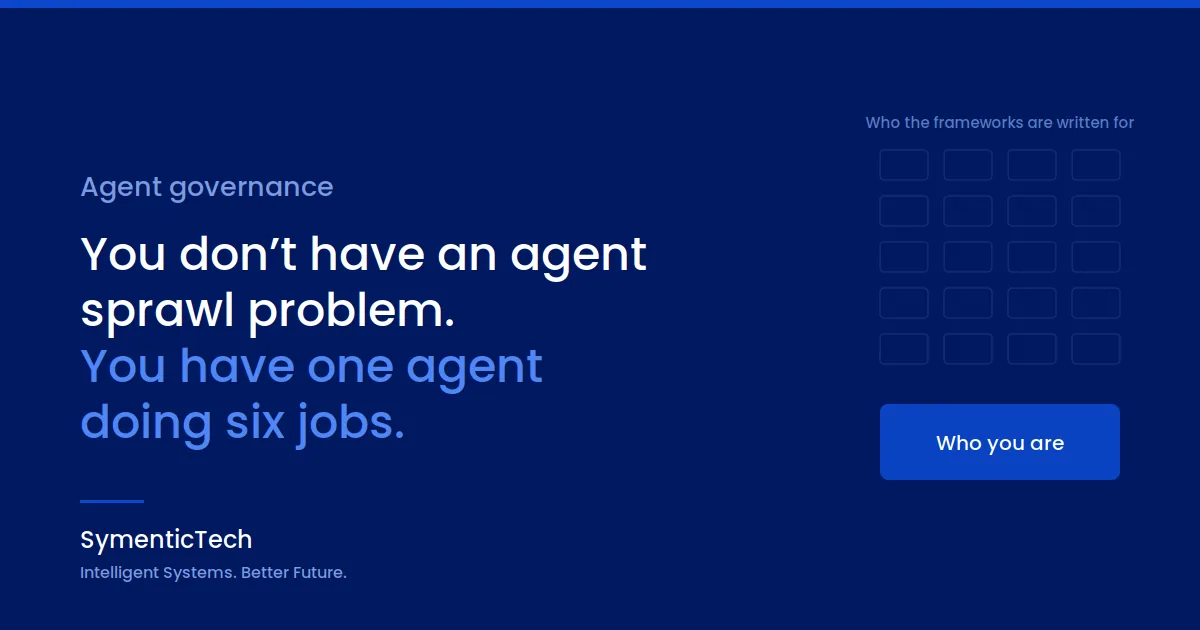
An enterprise gets in trouble because forty teams each built a research agent and nobody knows which one finance trusts. A 60-person company gets in trouble a completely different way: one agent quietly accumulates six jobs.
It starts scoped. It handles inbound enquiry triage. Then someone adds lead scoring, because the context is already there. Then draft replies. Then CRM updates, because why re-key. Then a weekly summary for the founder. Then, at some point, a step that touches invoicing.
Nobody made a bad decision. Each addition was a two-hour change to a thing that already worked. But the result is a single component with production credentials across four systems, no defined boundary, no test suite that covers the newer paths, and a blast radius that grew every time it got more useful.
Then the specific risk arrives, and it isn't a security breach. It's that the one person who understands the prompt chain, the edge-case handling, and why that particular retry logic exists takes another job. The agent keeps running. It also keeps drifting, because the underlying model gets updated on a vendor's schedule, not yours. Six weeks later the error rate has moved and nobody notices, because nobody was measuring it — measurement was going to happen after the next feature.
That's the small-company version. It doesn't show up in the sprawl statistics at all, because those surveys count agents, and you only have one.
Why the enterprise cure misfires at your scale
A governance council is overhead you can't amortize. Enterprise governance structures work because they spread a fixed review cost across hundreds of deployments. Run the same process over three agents and the process consumes more engineering time than the agents do. Teams respond by routing around it, which is how shadow AI starts — and shadow AI at your size means the founder wiring something up in a no-code tool at 11pm with a live API key.
A discovery tool has nothing to discover. AI TRiSM platforms exist to find the agents you don't know about. You know about all of yours. You could list them on a napkin. Buying tooling to inventory an inventory you can recite from memory is a real budget line solving an imaginary problem.
Standardizing on one runtime locks you in before you've learned anything. Enterprises consolidate because fragmentation already hurt them. You haven't fragmented yet. Committing to a single orchestration platform at agent number two trades optionality you still need for consistency you don't yet require.
The pattern underneath all three: enterprise governance is a response to scale that already happened. Applying it pre-emptively is paying the tax without having earned the income.
What actually protects a small agent portfolio
Four things. None of them require a platform purchase.
A hard boundary on what one agent is allowed to do. The cheapest control available to you is a written scope that a change request can violate. When the fifth new capability gets proposed, the question isn't "can it do that?" — it obviously can — but "is that inside the boundary we wrote?" If the honest answer is no, that's a second agent, with its own credentials and its own owner. Two narrow agents are easier to reason about, test, and switch off than one broad one. This is the only real sense in which you should want more agents.
A named owner, and a named second person. Not a team. A person, plus someone who could take over on two weeks' notice. If you can't name the second person, you don't have an operational system — you have a dependency on one employee's continued goodwill.
One number, checked monthly. Pick the single metric that would tell you the agent has degraded: escalation rate, correction rate, cost per task, whatever fits. Check it on a calendar reminder, not on vibes. Model updates change behaviour silently; the whole point of a monthly number is to catch drift you'd otherwise find out about from a customer.
A review date with a default of "off." Give every agent a date — six months out is reasonable — at which someone has to justify keeping it. The default at that date is decommission. This sounds harsh, and it's the single highest-leverage habit on the list, because the enterprise sprawl problem is largely a decommissioning failure: agents get deployed and never retired, and their credentials outlive them. You have the rare advantage of being able to build the habit before you have the mess.
A register that fits on one page
Not a platform. A spreadsheet, or a page in whatever doc tool you already pay for. One row per agent:
Field | Entry |
|---|---|
Agent name | |
What it is allowed to do (one sentence) | |
What it is explicitly not allowed to do | |
Systems it can read | |
Systems it can write to | |
Credentials it holds, and where they live | |
Owner | |
Backup owner | |
The one metric, and last checked | |
Review date (default: decommission) |
Ten fields. Fifteen minutes per agent. If you have three agents, this is forty-five minutes of work that gives you most of what a governance program is actually for — knowing what exists, what it can touch, who is accountable, and when it dies.
The row that does the most work is the third one. Almost nobody writes down what an agent is not allowed to do, and it's the field that makes scope creep visible at the moment it happens rather than eighteen months later.
The honest version
Read the enterprise research. It's good research, and the direction it describes — governance becoming a board-level question, agents outrunning the ability to account for them — is where the market is going.
Just don't confuse a forecast about the Fortune 500 with a description of your company. The organizations in those surveys are solving a problem they created by moving fast for three years with no controls. You are earlier than that, which means the useful thing to take from their experience is not their remedy. It's the knowledge of which specific habits, adopted now while they're free, mean you never need it.
SymenticTech builds and operates AI systems for teams that need them to work on Monday, not to impress a board. If you have an agent in production and nobody's entirely sure what it can reach, that's a good conversation to have early — we're happy to have it with you.